One of the things about owning an older narrowboat is that a simple problem can very quickly turn into an expensive solution.
Rasmunda was built in 1998, and although we’ve upgraded quite a few things since buying her, some of the original equipment is still doing perfectly well. One of those is the calorifier, basically the boat’s hot water cylinder.
Our hot water and central heating are provided by an Eberspächer Hydronic D5WSC diesel heater. It heats the radiators and, through a coil inside the calorifier, our domestic hot water.
It works very well.
The trouble is, diesel is getting rather expensive!
Diesel at £1.46 a litre changes the sums
Last winter, I was paying around £1.01 a litre for red diesel. Now it’s £1.46 a litre.
That’s an increase of 45p per litre, or nearly 45%.
With winter approaching, I’ve been filling Rasmunda’s tanks in preparation for the colder weather. Buying 60 litres at £1.46 costs £87.60. At last winter’s price, the same amount would have cost £60.60.
That’s £27 more for exactly the same amount of diesel.
I’m considering sending President Trump an invoice for the difference. Perhaps I’ll add a little for administration costs.
I won’t hold my breath waiting for payment. 😂
Of course, international fuel prices are influenced by all sorts of things, including conflicts, supply disruptions and decisions made by people who have probably never had to fill the diesel tanks on a narrowboat.
Whatever the explanation, Rasmunda’s Eberspächer doesn’t care. It still wants diesel.
So I started wondering whether electricity might now be a cheaper way of producing our hot water.
Eberspächer versus immersion heater
We had actually done this calculation before.
Rasmunda’s calorifier holds approximately 50 litres. The Eberspächer is a 5kW heater and, depending on its operating output, consumes approximately 0.27–0.62 litres of diesel per hour.
When we’re heating just the calorifier, around 30 minutes with the Eberspächer gets the water piping hot.
At £1.46 per litre, even assuming the heater ran at maximum fuel consumption for that entire half-hour:
0.62 litres × 0.5 hours × £1.46 = approximately 45p
Our marina electricity costs approximately 31p per kWh.
Heating 50 litres of water from around 15°C to 60°C theoretically requires about 2.6kWh of energy.
So an immersion heater would cost:
2.6kWh × £0.31 = approximately 81p
Allowing a little for heat loss, somewhere around 85–90p would be a reasonable estimate.
These are approximate figures rather than laboratory measurements, but they tell us something interesting.
Even with diesel at £1.46 a litre, the Eberspächer can still be cheaper than an immersion heater when its only job is heating the calorifier.
However, winter is a different story.
Our other source of winter heating
The Eberspächer isn’t actually our main source of heating once winter properly arrives.
Rasmunda also has a Reflex drip-feed diesel stove installed in the saloon.
Once the outside temperatures settle down to winter levels, we normally light the Reflex and leave it running 24 hours a day.
At the setting we usually run it, the Reflex consumes approximately 2.5 litres of diesel every 24 hours.
At £1.46 per litre, that’s about £3.65 a day.
It does a remarkably good job.
The saloon and kitchen stay lovely and warm, and enough heat finds its way through to the Carriage, our dinette area, to keep that comfortable as well.
What it doesn’t really heat is the bathroom and bedroom at the other end of the boat.
That’s actually how we like it. Neither Ann nor I particularly enjoys sleeping in a hot bedroom.
The Eberspächer therefore complements the Reflex rather than replacing it. It gives us radiator heat in the areas the stove doesn’t reach particularly well, while also producing our domestic hot water.
And that’s where our morning problem begins.
The winter morning problem
During winter, we normally run the Eberspächer for around two hours in the morning and three hours in the evening. If it’s freezing outside, it might run for six hours over the course of a day.
Because the radiators and calorifier are connected to the same heating circuit, warming everything takes considerably longer than simply heating the domestic water.
The first half-hour largely gets the system itself up to temperature.
After 45 minutes, the radiators are warming the boat nicely, but the domestic water isn’t always quite hot enough for a comfortable shower.
It normally takes an hour or a little longer before the calorifier is properly hot.
Our Eberspächer EasyStart timer is programmed to start the heater at 5:30am.
I get up at around 6:15am.
Now, I normally shower in the evening, but Ann prefers a morning shower. So we need the water hot when she gets up.
I began wondering whether an immersion heater could give the calorifier a quick boost without running the Eberspächer for longer.
And that led me towards replacing the calorifier.
£400 quickly becomes £520
The original calorifier was made specifically for Rasmunda. It’s now around 27 years old and, to be fair, it owes us absolutely nothing.
Unfortunately, it doesn’t have a connection for an immersion heater.
A suitable replacement calorifier costs approximately £400, and adding an immersion heater would bring the total to around £520.
The idea was quite attractive.
Let the Eberspächer start at 5:30am as usual, then switch on a 1kW immersion heater for perhaps 20 minutes to give the water a final boost.
A 1kW immersion heater running for 20 minutes consumes:
1kW × ⅓ hour = 0.33kWh
At 31p per kWh, that would cost just over 10p.
Of course, 20 minutes would only add a limited amount of heat, and whether that was enough for a comfortable shower would depend on how warm the water already was.
But it seemed worth considering.
Then I looked at another option.
What if I simply started the Eberspächer earlier?
That’s when I discovered that the calorifier wasn’t really the problem at all.
The two-hour problem
When we bought Rasmunda, the Eberspächer was operated by an old-fashioned pull-on, push-off switch.
Very simple. Pull it out and the heating starts. Push it in and the heating stops.
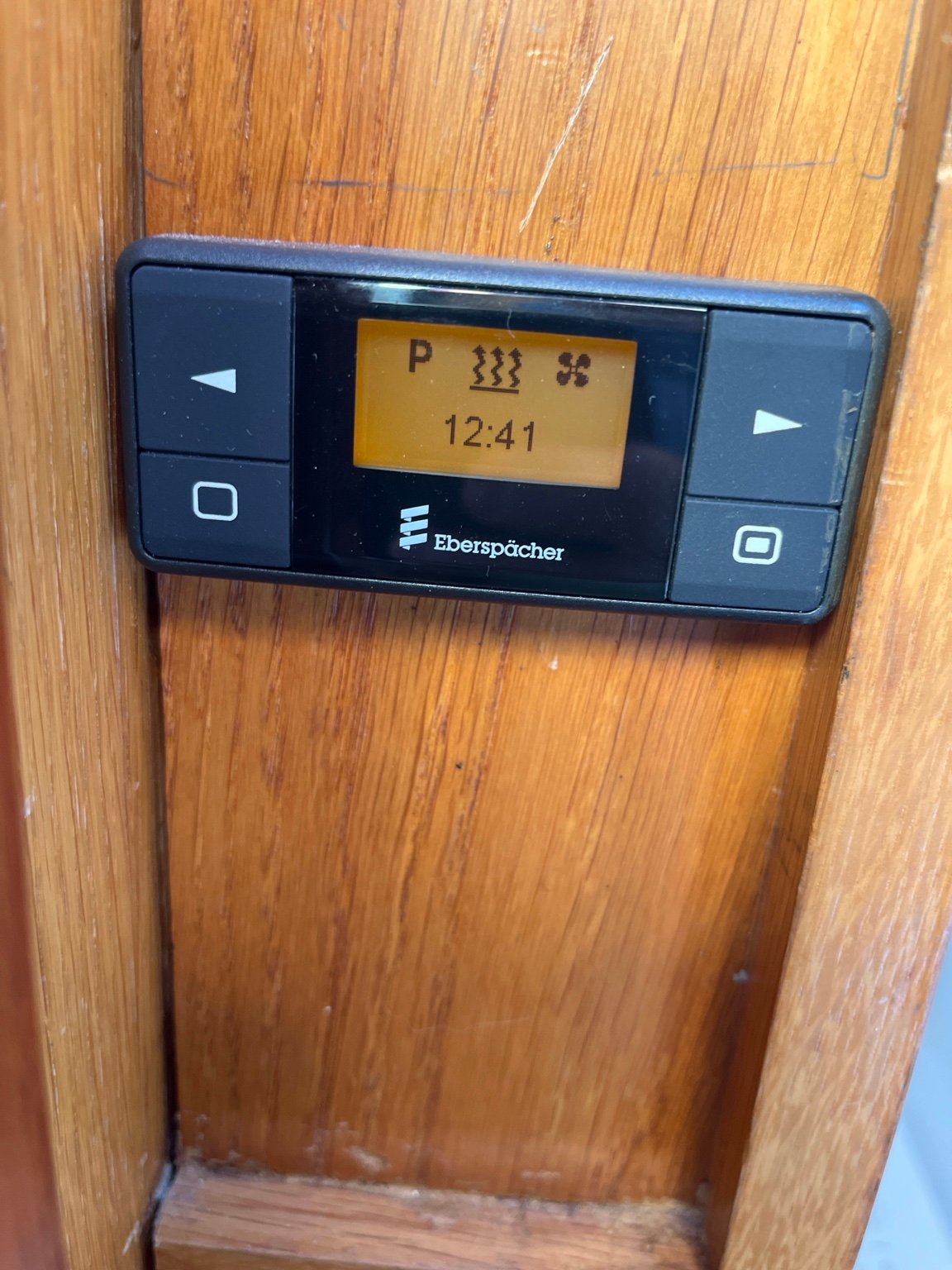
I subsequently replaced it with an Eberspächer EasyStart Timer.
It’s a useful bit of equipment because it allows us to programme the heating to start automatically.
Unfortunately, there’s a limitation.
A programmed heating period is restricted to a maximum of 120 minutes.
That’s fine much of the time, but what if I want the heater to start at 5:00am and continue running until 8:00am?
That’s three hours.
The heater itself is perfectly capable of running for much longer than two hours.
Digging into the EasyStart’s hidden service menu, I discovered that the manual heating duration on ours had been set to 250 minutes — four hours and ten minutes.
In fact, that manual setting can be increased all the way to 720 minutes, or 12 hours.
Unfortunately, it doesn’t alter the programmed timer. Scheduled heating periods are still limited to 120 minutes.
So the limitation wasn’t the Eberspächer itself. It was specifically the EasyStart’s programmed timer function.
I began looking for another controller.
Some were considerably more expensive than others, and it wasn’t immediately obvious that replacing the EasyStart would solve anything.
Then I remembered something.
Fortunately, I never throw useful wires away
When I originally fitted the EasyStart, I retained the wiring for the old pull-on/push-off switch.
At the time, I thought it might be useful if the electronic timer ever failed.
As it turned out, keeping those old wires was probably the best decision I’d made during the entire installation.
The original switch had a simple three-wire connection:
- Red: positive 12V supply.
- Brown: negative.
- Yellow: the Eberspächer’s S+ heating request signal.
On our particular installation, the original switch simply connected the positive supply to the yellow control wire when heating was required.
Remove that signal and the Eberspächer shuts itself down normally.
That last point is particularly important.
You must never simply cut the Eberspächer’s main electrical supply to stop it. The heater needs power to complete its proper shutdown and cooling sequence.
What we needed was something that could reproduce the operation of the original switch automatically.
In other words, a timer operating a relay.
Enter the £14.59 solution
After a little research, I found a Baomain THC15A 12V programmable timer.
Price?
£14.59.
It’s a digital timer designed to mount on a standard electrical DIN rail and provides 28 programmable ON/OFF events, together with manual switching.
More importantly, it has a set of independent relay contacts.
When programmed to switch on, the relay closes. When programmed to switch off, it opens again.
That means it should be possible to use the relay to reproduce the original Eberspächer switch without interrupting the heater’s permanent electrical supply.
The existing EasyStart can remain installed for manual operation and diagnostics.
And unlike the EasyStart’s programmed heating function, the Baomain allows us to specify the start and finish times.
For example:
05:00 — heating ON
08:00 — heating OFF
Three hours of heating without having to get out of bed to restart anything.
There’s just one slight complication.
Rasmunda’s 1998 electrical engineering
Rasmunda has an original 12V distribution panel fitted by Colecraft when she was built in 1998.
To put it politely, the electrical arrangement is rather unconventional.
There are old mains-style circuit breakers, an interesting collection of copper busbars and a distribution arrangement that I wouldn’t choose to reproduce today.
But it does have a DIN rail.
Better still, there’s a spare space at the top of the panel.
I measured it carefully.
37.4mm.
The Baomain timer is approximately 36mm wide.
That should fit.
Shouldn’t it?
Anyone who’s worked on an older boat will appreciate that those two measurements don’t necessarily mean the same thing.
Still, I ordered the timer.
A word of caution about compatibility
Before anyone rushes out to buy a Baomain timer and starts connecting wires, there’s something important to understand.
This is not a universal modification for every Eberspächer heater.
Rasmunda has an older 12V Eberspächer Hydronic D5WSC, part number family 25 2219, which supports an S+ switching-positive heating request.
On our installation, the original switch used that control method.
Other Eberspächer models and generations may use different control systems, including electronic communication such as LIN or CAN.
The model, exact part number and wiring diagram must be checked before attempting anything similar.
Wire colours alone are not enough to establish compatibility.
And, of course, any additional control must allow the heater to carry out its normal shutdown sequence. It must not simply interrupt the heater’s main power supply.
Have we saved £505.41?
Possibly.
We started by considering:
Replacement calorifier: £400
Immersion heater: £120
Total: £520
And now we have:
Baomain programmable timer: £14.59
Potential avoided expenditure: £505.41
Of course, the calorifier is still 27 years old and one day it’ll probably need replacing. When that happens, I’d certainly consider fitting an immersion heater for flexibility.
But replacing a perfectly functioning calorifier simply because the central heating doesn’t start early enough seems rather unnecessary.
Sometimes the best solution isn’t replacing the expensive bit.
It’s discovering what the actual problem is.
All that remains now is for the £14.59 timer to arrive, squeeze into its 37.4mm gap and persuade the Eberspächer to obey its new master.
How difficult could that possibly be?
Find out in Part 2, where Rasmunda’s original electrical installation has a few surprises waiting for me.
And if all else fails, I still have the original pull-on switch.
At least that doesn’t need programming. 😂