In Part 1, I explained how a fairly simple problem with Rasmunda’s hot water nearly resulted in me spending £520 on a replacement calorifier and immersion heater.
Missed the beginning? Read Part 1 — How a £520 Narrowboat Hot Water Upgrade Turned Into a £14.59 Timer
The existing calorifier was working perfectly well. The real problem was getting our Eberspächer diesel central heating to run automatically for longer than the two hours allowed by its EasyStart Timer.
After a fair bit of research, I came up with a possible solution.
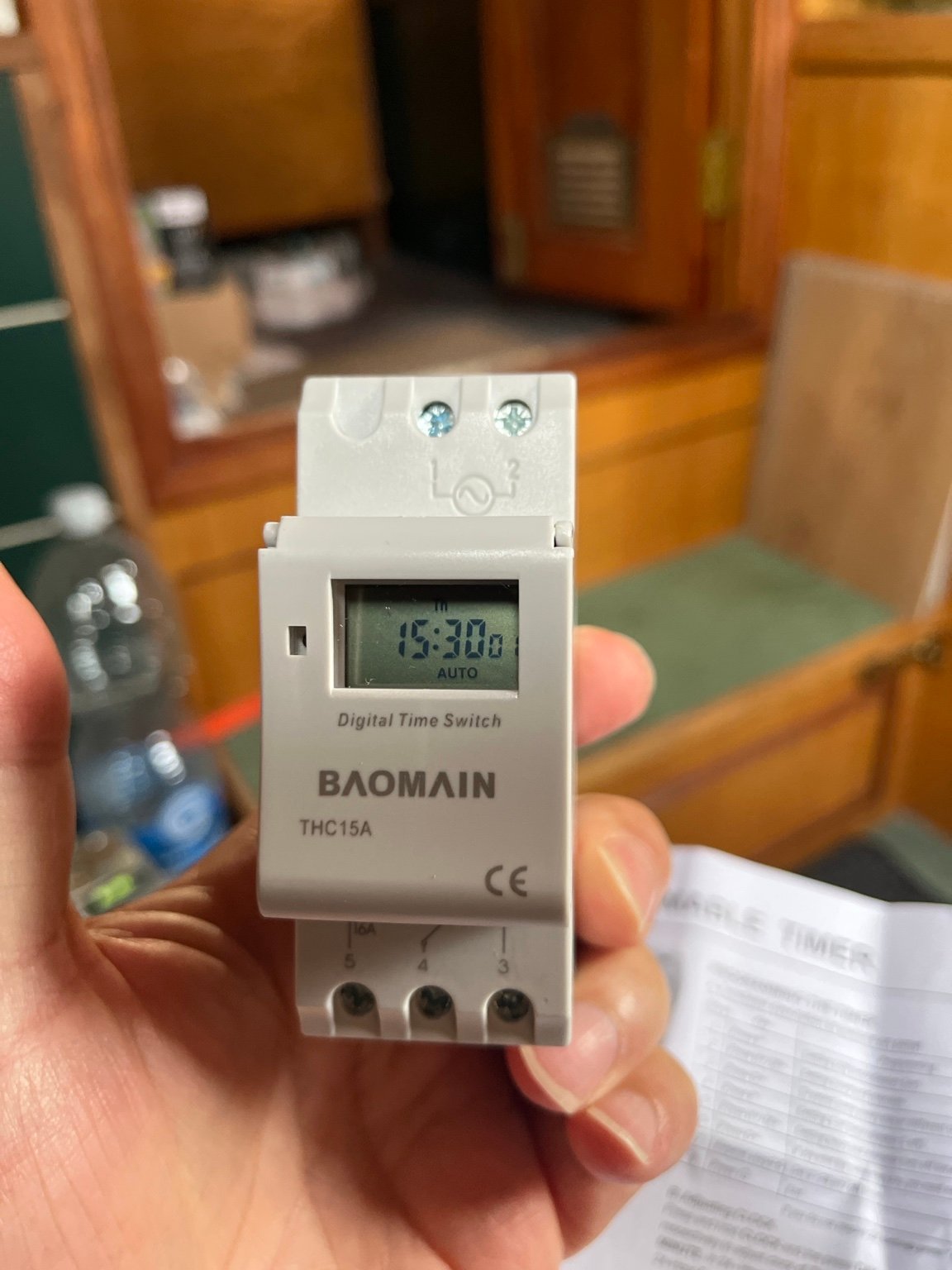
A £14.59 Baomain programmable timer.
It sounded almost too simple.
All I had to do was fit it, connect it to the Eberspächer and programme the heating to come on and off when we wanted.
What could possibly go wrong?
Well, this is Rasmunda, a narrowboat built in 1998. Nothing is ever quite that straightforward.
The new timer arrives
The Baomain THC15A arrived the following day.
It’s a small digital timer designed to fit onto a standard DIN rail, the metal mounting rail commonly found inside electrical distribution panels.
It runs on 12 volts and has a programmable relay which can switch an external circuit on and off.
More importantly, it allows up to 28 ON/OFF events to be programmed, giving us far more flexibility than the Eberspächer EasyStart’s two-hour programmed heating periods.
The plan was to retain the existing EasyStart Timer and use the Baomain as an additional controller.
I’d already discovered that Rasmunda’s original Eberspächer pull-on switch used a simple switching-positive control signal to start the heater.
The Baomain’s relay could reproduce that same switching action.
At least that was the theory.
First, however, I needed somewhere to install it.
Colecraft’s interesting approach to electrical engineering
Rasmunda still has her original 1998 electrical distribution panel.
Now, I should explain that I have a background in marine electrics, having installed the electrical systems aboard our 44-foot sailing yacht, Ruffles Spray, which we built ourselves.
Consequently, I tend to take rather more interest in boat wiring than is perhaps healthy.
And Rasmunda’s original distribution panel has certainly given me something to think about.
For a start, it uses old 230/400-volt AC-style circuit breakers in a 12-volt DC installation.
Then there’s the copperwork.
Instead of the sort of positive and negative distribution arrangement I’d normally expect to see, Colecraft had used a substantial copper strip connecting one side of the individual breakers, with another copper link running across to the negative busbar.
An interesting arrangement, to put it politely.
It’s something I’d like to replace with a properly designed DC distribution system eventually.
But not today.
Today I simply wanted to install a £14.59 timer.
I looked inside the panel and discovered a spare section of DIN rail above the existing breakers.
Out came the vernier calipers.
Available space: 37.4mm.
Baomain timer width: approximately 36mm.
Excellent!
I had a whole 1.4mm to spare.
Plenty of room.
Or so I thought.
The copper strip strikes again
I offered the Baomain up to the DIN rail.
It wouldn’t fit.
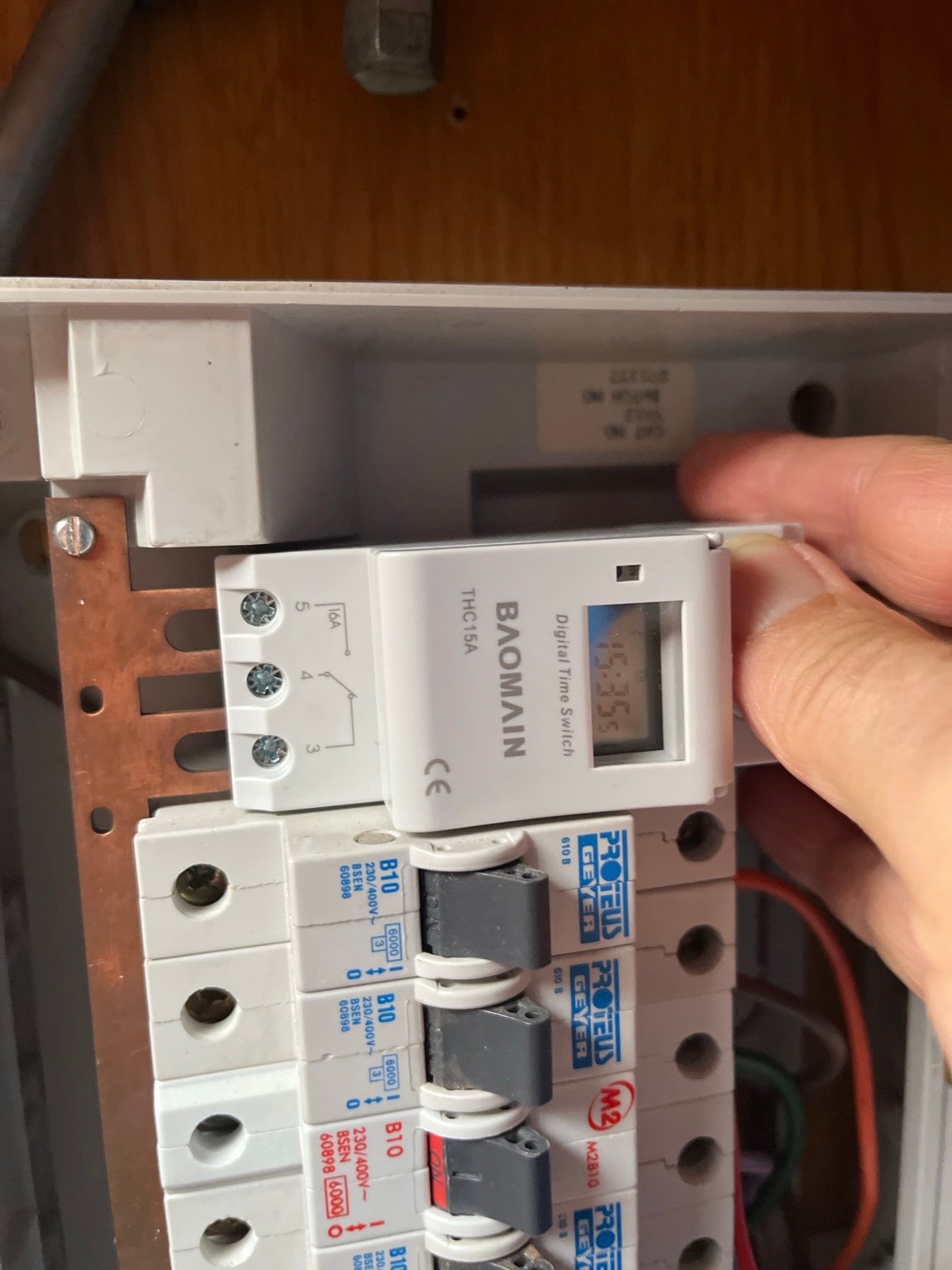
The body of the timer was being obstructed by the copper strip extending above the first breaker.
Of course it was.
I’d measured the space between the existing breaker and the plastic housing perfectly, but hadn’t allowed for Colecraft’s little contribution to electrical engineering lurking behind it.
One thing about owning an older boat: it’s very easy to turn a half-hour job into a complete refit.
And I had absolutely no intention of doing that.
Well, not this time anyway.
After investigating how the copper busbar was connected, I established that the section extending above the first circuit breaker wasn’t serving any useful purpose.
The solution was straightforward enough. With the electrical supply isolated, I carefully cut back the unused section of copper, making sure the remaining connections weren’t disturbed. I then cleaned up the cut edge and checked everything before fitting the timer.
Finally, the Baomain clipped neatly onto the DIN rail.
Success!
One £14.59 timer installed, although it had required a minor alteration to some 28-year-old copperwork to get there.
I should point out that the existing copper arrangement is part of Rasmunda’s electrical distribution system, so this isn’t something I’d recommend anyone start cutting without first understanding precisely what it connects to.
At some point, I intend to replace the whole distribution panel with something more appropriate for a modern 12V installation.
But that’s another job for another day.
And I suspect that one won’t cost £14.59. 😂
Testing the Baomain
Before connecting anything to the Eberspächer, I wanted to establish exactly how the new timer operated.
The Baomain has a 12-volt power input and a separate set of changeover relay contacts.
That’s important because we didn’t want to switch the Eberspächer’s main electrical supply.
We only wanted to reproduce the command given by its original ON/OFF switch.
Using my multimeter, I checked the contacts with the relay off, then powered the Baomain and checked them again with the relay switched on.
Everything behaved exactly as it should.
With the timer OFF, the normally open contacts were open.
With the timer ON, they closed.
So far, so good.
The next question was whether the Eberspächer would agree.
Would the Eberspächer actually start?
Rasmunda’s heater is a 12-volt Eberspächer Hydronic D5WSC, part number family 25 2219.
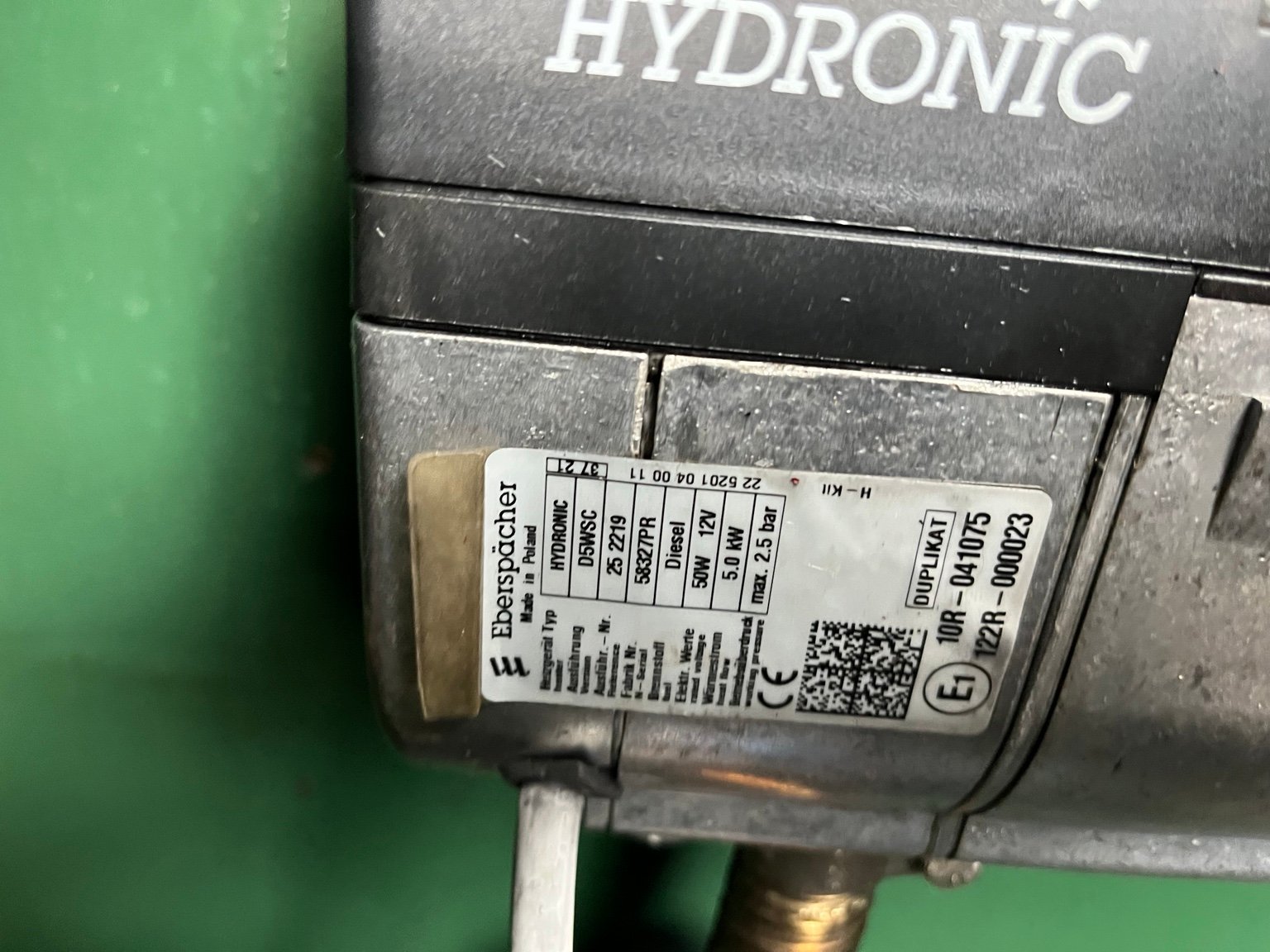
When I’d fitted the EasyStart Timer previously, I’d kept the original switch wiring and connector, just in case it was ever needed.
I’m rather glad I did.
The original switch operated through the heater’s S+ control input. The Baomain was connected so its relay could reproduce that original heating request, while the existing EasyStart remained installed.
With everything checked, I switched the Baomain manually to ON.
Click.
Then came the familiar sounds from the Eberspächer.
The heater had accepted the signal and was going through its normal startup routine!
A few minutes later, it was running normally.
That was the first half of the test completed.
But the second half was actually more important.
The shutdown test
Diesel-fired heaters such as the Eberspächer don’t appreciate having their main electrical supply suddenly disconnected while they’re running.
They need to complete a controlled shutdown sequence, which includes running the combustion-air fan during the cooling and purge process.
That’s why the new timer was switching the heating request rather than the heater’s permanent power supply.
After letting the Eberspächer run, I switched the Baomain to OFF.
Another click.
The heater stopped producing heat, but I could still hear it running through its shutdown sequence.
The fan continued for roughly another minute before everything went quiet.
Perfect.
That’s exactly what I wanted.
The Baomain could start the Eberspächer and request a normal shutdown, without interfering with its permanent supply.
Our £14.59 experiment had passed its first proper test.
Now it was time to programme it and see what happened the following morning.
The first overnight test
The forecast was for approximately 10°C overnight.
Not particularly cold, but cool enough to give the heating a proper test.
I programmed the Baomain to:
ON: 05:30am
OFF: 07:00am
A total running time of 90 minutes.
Yes, I know.
After all that effort to overcome the EasyStart’s two-hour limitation, my first programme was for an hour and a half.
But the whole point was flexibility. When winter really arrives, I’ll be able to start the heater earlier and run it for three hours or longer if necessary.
Having set the programme, I left everything alone and went to bed.
A warm Rasmunda and piping-hot water
I got up at about 6:15am.
The Eberspächer had started automatically at 5:30am, exactly as programmed.
The temperature in the saloon was already 18.5°C.
Not bad after just 45 minutes.
By 7:00am, the temperature had reached 20°C.
And the domestic hot water?
Piping hot!
At precisely 7:00am, the Baomain switched the heater off and the Eberspächer went through its normal shutdown routine.
No intervention required.
No getting up early to press buttons.
No restarting the heating because a programmed period had expired.
It had simply done what we’d asked it to do.
I must admit, I was rather pleased with myself.
One final adjustment from management
There was, of course, one small detail I’d overlooked.
The original idea had been to make sure the water was hot enough for Ann’s morning shower.
I’d been worrying about whether the calorifier would be hot enough by 6:15am, when I normally get up.
Then it dawned on me.
Ann doesn’t get up until 7:00am.
So, in fact, we already had everything exactly where we needed it.
By the time management appeared, the boat was lovely and warm and the hot water was ready.
Perhaps I should have established the actual shower requirements before spending several days redesigning the heating controls.
Still, at least the specification change didn’t cost anything.
That’s a first. 😂
What about proper winter weather?
The first test was successful, but 10°C outside isn’t exactly a challenging winter night.
When temperatures get down towards freezing, Rasmunda’s Reflex diesel stove will already be running around the clock, keeping the saloon, kitchen and much of the Carriage warm.
The Eberspächer will then give us additional radiator heating, particularly towards the bathroom and bedroom, while heating the calorifier.
If we need more heat in the morning, I can simply change the Baomain programme.
Perhaps 05:00–08:00.
Or earlier still if it’s particularly cold.
And with its multiple ON/OFF programmes, I can also arrange the evening heating to suit the weather and how we’re using the boat.
The real advantage isn’t that the heating now has to run longer.
It’s that we can choose how long it runs, rather than having the timer make that decision for us.
We’ll see how well the arrangement performs when winter properly arrives.
A word of caution
I should emphasise that this modification was carried out on Rasmunda’s particular Eberspächer installation.
Our older D5WSC accepts an S+ switching-positive heating request. Other Eberspächer models may use different control methods, including electronic communication systems.
This isn’t a universal wiring modification, and nobody should assume that connecting a timer to similarly coloured wires on another heater will have the same result.
The exact heater model, wiring diagram, supply protection and control method all need to be established first.
Most importantly, the heater must retain the electrical supply it requires to complete its normal shutdown and cooling cycle.
The fact that a small programmable timer can operate a relay doesn’t mean it can safely replace every type of diesel-heater controller.
So, was the £14.59 timer worth it?
Absolutely.
We started this little investigation wondering whether to replace Rasmunda’s original calorifier.
That would have cost approximately:
New calorifier: £400
Immersion heater: £120
Total: £520
Instead, we bought:
Baomain THC15A programmable timer: £14.59
That’s a difference of £505.41 in proposed equipment expenditure.
Of course, the two options aren’t identical. A new calorifier and immersion heater would provide an additional means of heating our domestic water, which may be useful in the future.
And eventually, Rasmunda’s original calorifier will probably need replacing.
But our immediate problem was simply getting the Eberspächer to operate automatically for the periods we wanted.
And the little Baomain has solved that.
So we’ve kept the original calorifier, retained the EasyStart Timer and gained much more flexibility over when the central heating operates.
We’ve also discovered a few things about Rasmunda’s original electrical distribution panel that will no doubt lead to another project.
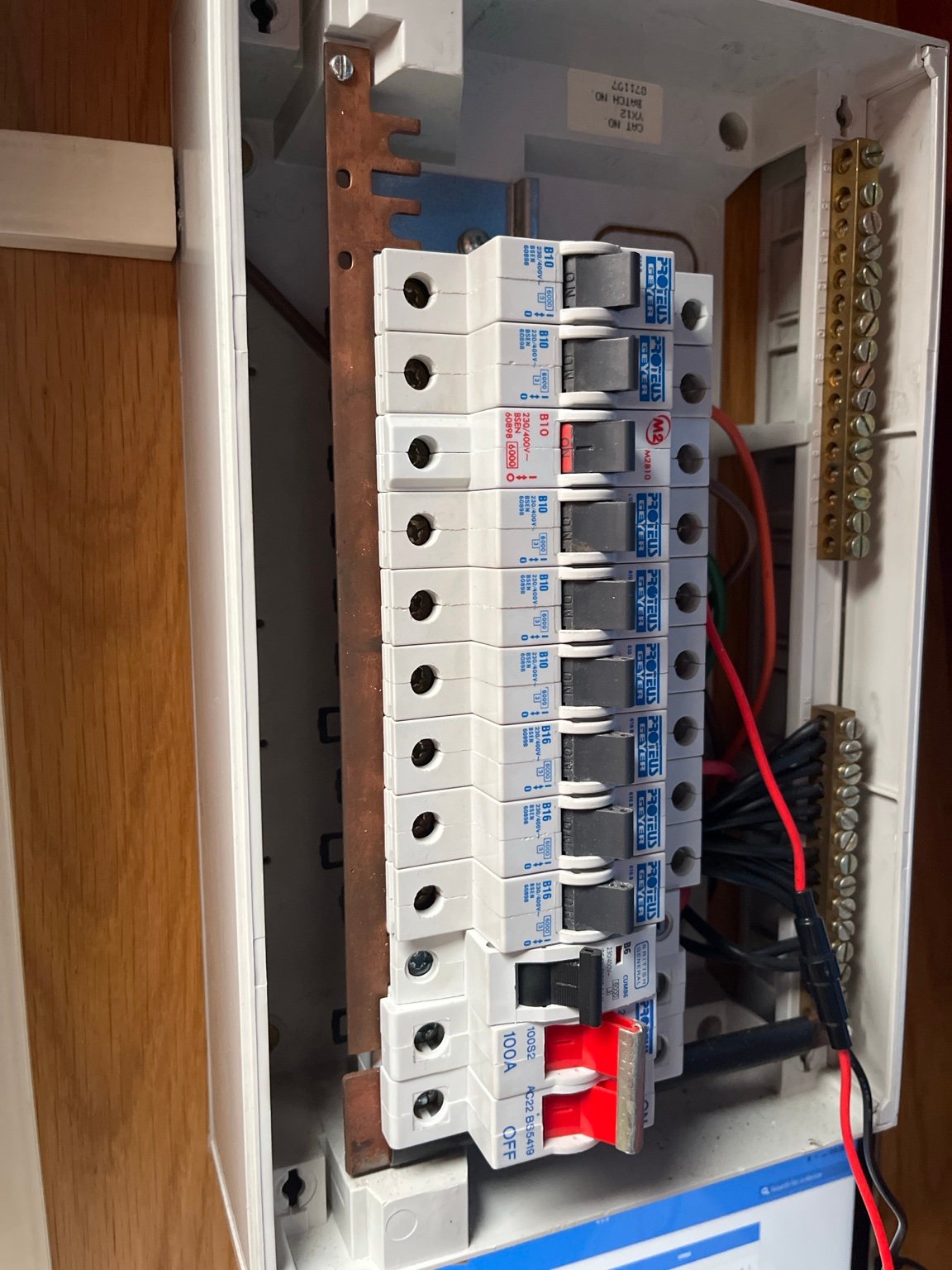
I’m trying not to think about that one just yet.
For now, I’m happy with the result.
£14.59, a few hours of investigation, some electrical work and a warm boat with piping-hot water by 7:00am.
Not a bad outcome.
And the best bit?
I didn’t have to ask Ann’s permission to install another white box on the woodwork.
This one’s hidden inside the electrical panel.
Sometimes it’s the little victories that matter. 😂