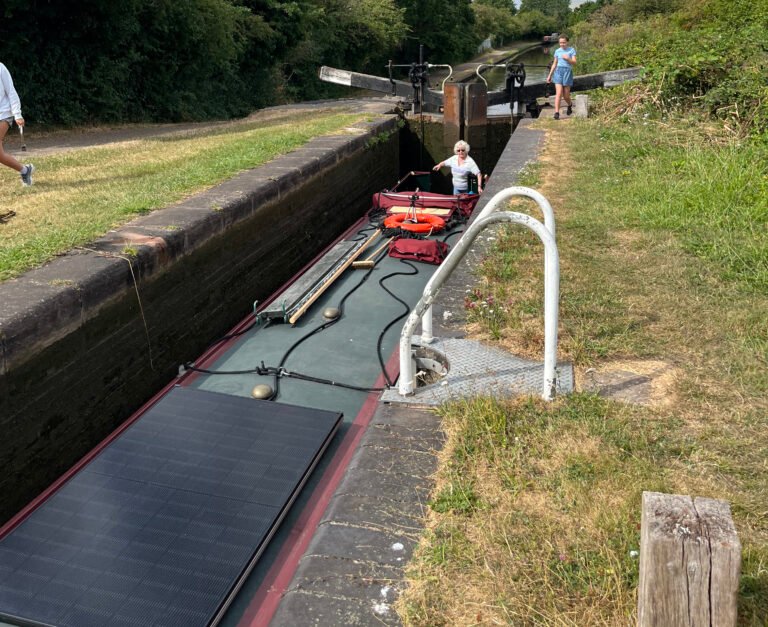
When Ann and I retire in spring 2028, we intend to spend considerably more time cruising aboard our 60-foot narrowboat, Rasmunda.
But we won’t be making any major changes to her electrical installation.
There’s a simple reason for that. I designed the system around the way we intend to live.
We’ll retain our residential mooring, spend approximately May through September exploring the inland waterways, and return to our home berth for winter.
But suppose we decided to give up our mooring altogether and become full-time, year-round continuous cruisers.
Would I keep our existing 280Ah lithium battery? Would 515W of solar be sufficient? Would I install a larger alternator, a more powerful inverter or perhaps a generator?
Having spent more than 25 years living aboard boats, building and maintaining marine electrical systems, and occasionally learning lessons the expensive way, I have some fairly definite ideas about what I’d install.
And they might not be what you’d expect.
First, How We Actually Intend to Cruise
When I retire, Ann and I plan to spend around five months each year cruising the waterways.
One year we might head towards Liverpool and back. Another year might take us towards Stockton and Manchester.
We’ll plan our routes, work out the locks and cruising distances, and allow plenty of time to explore the places we visit.
After all, what’s the point of cruising through somewhere interesting if you never stop long enough to enjoy it?
Our intention is to cruise for a few hours, find somewhere pleasant to moor, and perhaps stay for two or three days before moving on.
During the warmer months, our 515W solar panel should make a substantial contribution to our electricity requirements. And whenever we’re cruising, the engine alternator can replenish the domestic battery.
If we encounter several days of miserable weather, we have another option.
Our Aquavista residential mooring arrangement includes visiting benefits at other marinas within its network, subject to the scheme’s conditions and berth availability.
So rather than sitting on the towpath watching the battery’s state of charge fall, we could head for a marina and use shore electricity where available.
We also intend to carry a small Honda petrol inverter generator as an additional backup.
But a full-time continuous cruiser who has no permanent mooring faces a different set of challenges, particularly during winter.
That’s the installation I want to consider here.
What We Already Have Aboard Rasmunda
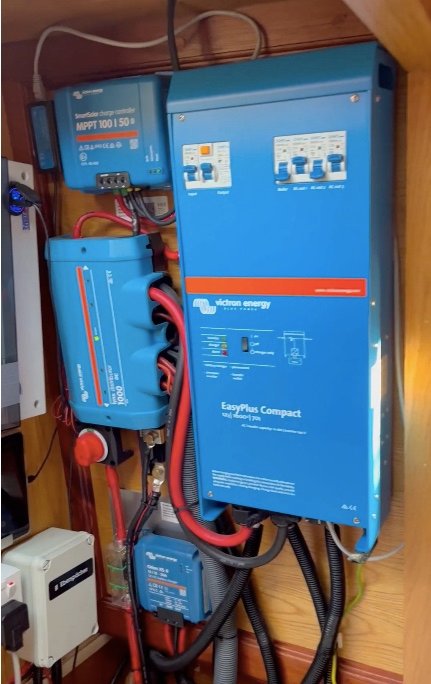
Our present electrical installation is relatively straightforward.
| Equipment | Existing installation |
|---|---|
| Domestic battery | 280Ah Fogstar LiFePO4 |
| Solar panel | 515W |
| Solar controller | Victron SmartSolar MPPT 100/50 |
| Engine charging | Victron Orion 12/50 DC-DC charger |
| Inverter/charger | Victron EasyPlus 1600/70 |
| Shore power | Metered residential connection |
The system provides several ways to supply our electrical requirements.
During daylight hours, the solar panel generates electricity whenever conditions permit.
While cruising, the alternator provides charging through the Orion DC-DC charger.
And when we’re connected to shore power, the EasyPlus can charge the battery and supply our 230V appliances.
I’ve also configured the Victron equipment to make use of its conditional AC input connection feature, allowing us to supply smaller loads from the inverter while using shore electricity for larger demands.
It’s an arrangement that works well for us.
But before deciding what I’d change for continuous cruising, there’s a more fundamental question.
How Much Electricity Do We Actually Use?
I think this is where every narrowboat electrical installation should begin.
Not with a battery catalogue.
Not with the biggest inverter you can afford.
And certainly not with somebody else’s idea of how much solar you need.
Start by working out how much electricity you actually consume.
During my years working on marine electrical installations, I developed an Excel power estimator to help boat owners calculate their likely daily requirements.
The principle is simple.
List your appliances, establish their electrical consumption, estimate how long they’re used each day, and calculate the total.
Of course, that’s easier said than done.
The Problem With Appliance Ratings
Take a washing machine.
Its rating plate might state 1,400W.
But that doesn’t mean it consumes 1,400W continuously throughout a washing cycle.
The heating element may only operate for part of the programme, or not at all under certain conditions.
Our 6kg washing machine aboard Rasmunda uses approximately 9Ah from the lithium battery during a 15-minute, 30°C wash in summer, based on observations using the VictronConnect and Fogstar apps.
That’s considerably less than you might expect from simply looking at its maximum power rating.
We had a similar experience aboard Ruffles Spray.
Our little Candy 3.5kg washing machine could complete a wash using approximately 6Ah when conditions were favourable.
When the incoming water was colder and the heating element operated, consumption could rise to around 22Ah.
Same appliance. Different circumstances. Very different electrical consumption.
That’s why I always prefer actual measurements where they’re available.
Two Fridges and a Reality Check
Rasmunda has two refrigerators.
The main one is a relatively new 92-litre larder fridge. The other is a much older, smaller 12V fridge that we mainly use for drinks.
The older fridge is unlikely to be as efficient as the newer one.
Initially, I estimated their consumption using assumed compressor running times.
But refrigerators don’t operate continuously. Their compressors cycle on and off according to temperature, thermostat settings and other conditions.
After reconsidering the figures, I think a combined consumption of approximately 50–60Ah per day is a more realistic working estimate for our two fridges.
That’s equivalent to an average current of roughly 2.1–2.5A across both appliances.
It’s still an estimate, but one informed by experience.
What Happens Overnight?
During summer, I experimented with running Rasmunda’s domestic electrical system from solar and battery power while we were on our mooring.
I remember the battery’s state of charge falling by approximately 15 percentage points overnight.
With our 280Ah Fogstar battery, that represents roughly 42Ah.
If we assume solar generation effectively stopped around 9 pm and resumed around 6 am, that’s nine hours without meaningful charging.
The average battery discharge would therefore have been approximately 4.7A.
That includes both fridges and all the other electrical equipment operating overnight.
It’s a useful observation, although I wouldn’t pretend it was a precisely controlled experiment.
But it gives us something far more valuable than a manufacturer’s brochure.
A reasonable indication of what actually happens aboard our boat.
What About Solar Generation?
Our solar installation has provided some interesting figures.
During one seven-day summer period, the Victron SmartSolar controller recorded daily generation ranging from approximately 1.21kWh to 2.13kWh.
The average was around 1.60kWh per day.
That’s a substantial amount of electricity from a single 515W panel.
For comparison, 1.60kWh represents approximately 125Ah when expressed at a nominal 12.8V battery voltage.
Naturally, the actual battery charging current and amp-hours depend on operating voltage and system conditions.
But the figures demonstrate how useful solar can be during the warmer months.
There’s another important point here.
When Rasmunda is connected to shore power and the battery charger is maintaining the battery, the solar controller may deliver relatively little energy.
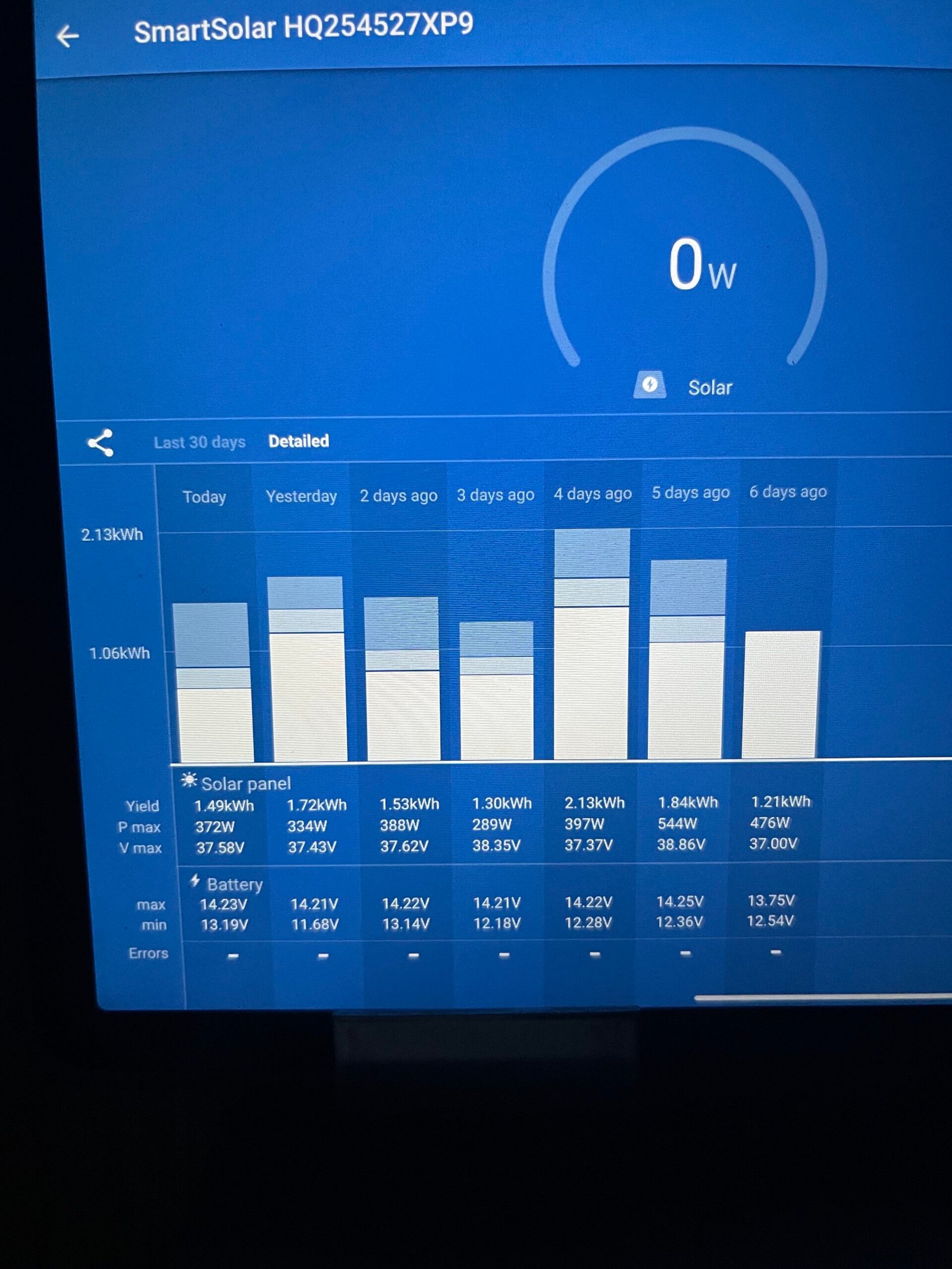
That doesn’t necessarily mean the panel couldn’t have produced more.
It simply means the battery didn’t require it.
So a Victron solar history graph tells you how much energy the controller delivered, not necessarily the maximum amount the panel could have generated under those conditions.
This distinction matters when trying to estimate how a boat would perform completely off-grid.
What Does My Power Estimator Predict?
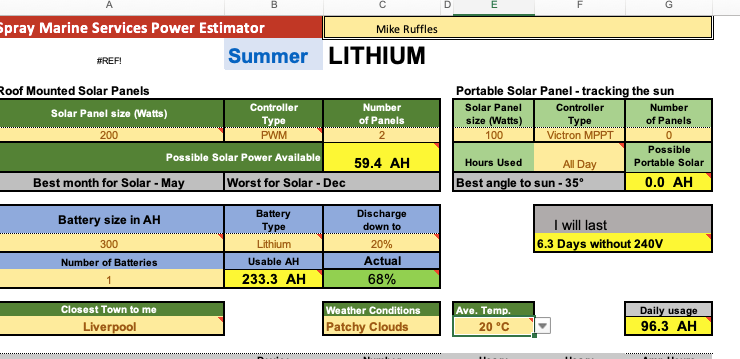
Using my Excel power estimator, I modelled a representative May cruising scenario around Liverpool.
I selected approximately 500W of solar and a 300Ah lithium battery, the closest available settings to Rasmunda’s existing installation.
After reviewing the appliance entries and removing a duplicated inverter standby allowance, the spreadsheet showed approximately 116Ah of daily consumption.
The solar estimate for the selected conditions was approximately 95Ah per day.
That suggests a daily shortfall of around 21Ah.
However, the refrigerator entries still need updating to reflect my latest estimate of their combined consumption.
So the 116Ah figure is an intermediate calculation, not a final forecast.
The spreadsheet is only as accurate as the assumptions entered.
I wouldn’t treat the resulting battery endurance as a promise.
What matters to me is whether Rasmunda can comfortably remain moored for two or three days without running the engine.
For our intended summer cruising, I believe the existing installation is a sensible arrangement.
But for year-round continuous cruising, I’d make several changes.
Change One: Double the Lithium Battery Capacity
My first change would be straightforward.
I’d add another 280Ah Fogstar lithium battery, increasing the domestic bank to 560Ah.
At a nominal 12.8V, that represents approximately 7.17kWh of stored energy.
But there’s an important distinction.
I wouldn’t double the battery capacity because I wanted to use twice as much electricity.
I’d do it for additional reserves.
Imagine we’re moored somewhere remote and the engine develops a problem.
Suddenly, we’ve lost not only propulsion but also one of our principal methods of charging the batteries.
I might be able to repair the engine myself.
Alternatively, we might need to wait for someone to come and help.
Either way, I don’t want to be worrying about the domestic electricity supply while trying to resolve the engine problem.
A larger battery bank gives us more time.
It also provides additional reserves during prolonged periods of poor solar generation.
But there’s one thing I always emphasise.
A battery stores electricity. It doesn’t generate it.
Doubling your battery capacity won’t produce a single additional amp-hour.
You still need a reliable way of replenishing what you’ve used.
And that brings us to the alternator.
Change Two: Improve Alternator Charging
Rasmunda currently has a Victron Orion 12/50 DC-DC charger.
The system works, but alternator output at engine tickover is marginal.
I’m planning to experiment with pulley ratios to see whether I can improve the available charging current at lower engine speeds.
If I were designing the installation specifically for full-time continuous cruising, I’d consider a 140A alternator, with the pulley ratios selected to provide useful output at the engine speeds we normally use.
I’d initially aim for approximately 30A of alternator output at tickover, subject to testing.
At higher engine speeds, considerably more current should become available.
I’d also consider upgrading to a suitably specified Victron Orion 70A DC-DC charger.
But there’s a technical point worth explaining.
A 140A alternator doesn’t necessarily produce 140A at low engine speeds.
And installing a 70A DC-DC charger doesn’t mean you can draw 70A from an alternator that is only producing 30A.
The charging current must be matched to the available alternator output.
Pulley ratios, alternator temperature, belt loading and the engine’s other electrical demands all need consideration.
I’d also want to establish that the alternator could sustain the required output without overheating.
Would I Fit a Second Alternator?
Not at present.
I’ve heard conflicting accounts about connecting certain Victron Orion DC-DC chargers directly to a dedicated alternator without a starter battery providing an electrical buffer.
Until I have confirmation from Victron about the correct arrangement for the specific equipment, I wouldn’t advocate that configuration.
I’d retain the conventional charging arrangement through the starter-battery electrical system.
I’m perfectly happy to experiment with my own equipment when I understand the implications.
But I won’t recommend an installation to readers unless I’m satisfied that it’s technically sound.
Change Three: Install a 3kW-Class Victron MultiPlus
Our existing Victron EasyPlus 1600/70 is perfectly adequate for our present requirements.
But for full-time continuous cruising, I’d consider replacing it with a 3kW-class Victron MultiPlus.
Not because I want to run a 3kW kettle.
And not because I think every narrowboat needs an enormous inverter.
My reasoning comes from an experience aboard Ruffles Spray many years ago.
A Lesson From the Vlicho Storm
In 2011, Ann and I were anchored aboard Ruffles Spray in Vlicho Bay, on the Greek island of Lefkada, when an exceptionally violent storm swept through the anchorage.
It subsequently became known among cruising sailors as the Vlicho storm, or Vlicho disaster.
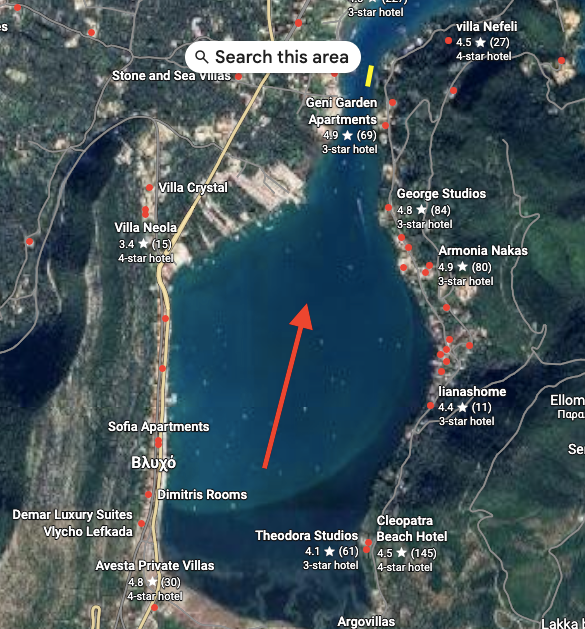
We were directly in its path.
I watched our NASA Clipper wind-speed indicator climb to an astonishing 120 knots before the masthead instrument was destroyed.
Fortunately, before leaving the UK to return to the Mediterranean, we’d invested in a new 34kg Rocna anchor.
That anchor held Ruffles Spray securely while other boats around us dragged their anchors.
It was a frightening experience.
We remained anchored in the bay for several more days afterwards, helping others deal with the consequences.
One of our own casualties was the wind-speed instrument.
Rather than climb the foremast, replace the masthead unit and run new cabling down through the mast, I decided to mount its replacement on our aft stainless-steel gantry.
I still had a length of 25mm stainless-steel tubing left over from Ruffles Spray’s extensive 2006 refit.
I fabricated a mounting post, welded it onto the gantry, installed the replacement NASA Clipper wind-speed indicator and ran its cable directly to the cockpit.
And I powered the welder using our Victron MultiPlus inverter.
No shore electricity. No shoreside workshop. Just the equipment we already had aboard.
That’s why I’d choose a 3kW-class MultiPlus for a narrowboat intended for full-time continuous cruising.
Not because I need that much power every day, but because having the capability to operate tools and carry out repairs independently can be invaluable.
Of course, the inverter, batteries and cabling must be capable of supplying the particular welder’s electrical demand.
But for me, having that additional capability available is an important part of living aboard.
The full story of the Vlicho storm, including how Ruffles Spray survived while other boats dragged, is one of the experiences I intend to recount in Getting There, the third book in our Getting Away series.
Change Four: Keep the Solar Panel
This might sound obvious today, but solar electricity wasn’t always as affordable as it is now.
Back in 2006, we installed four 90W solar panels aboard Ruffles Spray.
That’s 360W in total.
Each panel cost approximately £300.
The Blue Sky MPPT 50 solar controller cost another £500.
By the time we’d added the wiring, ancillary equipment and stainless-steel gantry, the total cost was approximately £3,700.
And that excluded my labour.
I fabricated and welded the gantry myself.
It was a considerable investment.
Solar worked well when the sun was shining.
But during prolonged cloudy weather, generation fell dramatically.
By 2014, I remember discussing solar installations with a customer and remarking that, given the expense and the limitations we’d experienced, I might have considered a generator instead.
Today, things are very different.
Solar panels and controllers are substantially more affordable.
So I’d certainly retain Rasmunda’s 515W solar installation.
During summer, it can supply a significant proportion of our electricity requirements.
But I wouldn’t rely on solar alone for year-round continuous cruising.
Particularly during a British winter.
Change Five: Carry a Small Petrol Generator
I once considered whether a built-in marine diesel generator might be the ideal solution.
Something around 2.5–3.5kW would provide a substantial independent electrical supply.
But a properly installed marine diesel generator is an expensive piece of equipment.
There’s the generator itself, cooling arrangements, exhaust system, fuel supply, electrical installation and ongoing maintenance.
Depending on the installation, the cost can run into many thousands of pounds.
For my purposes, I don’t think that expenditure would be justified.
Instead, I’d carry a small Honda 1kW-class petrol inverter generator.
Its primary purpose wouldn’t be to run domestic appliances.
It would be to recharge the lithium batteries when solar generation and engine charging weren’t sufficient.
Could a 1kW Generator Charge a 560Ah Lithium Bank?
Yes, provided the charger is configured appropriately.
But it won’t recharge the entire bank quickly.
I’d initially investigate limiting the MultiPlus AC input to around 4A and setting the battery charging current to a level the generator could sustain.
A charging current of 50A at approximately 14V represents around 700W of DC charging power.
Allowing for charger losses and other electrical demands, that could be close to the continuous capacity of a small generator.
So the final charging settings would need to be established by testing with the particular generator and charger.
The objective wouldn’t be maximum charging current at all costs.
It would be reliable, efficient charging without overloading the generator.
Naturally, a petrol generator must be operated outdoors in a safe position, with particular attention to exhaust gases, carbon monoxide, fuel storage and electrical connection arrangements.
I’d also take account of local restrictions and other boaters.
How Often Would I Run It?
Ideally, not very often.
During summer, solar and engine charging would do most of the work.
If we remained moored for several days in poor weather, I’d use the generator when necessary to replenish the batteries.
Perhaps every two or three days, depending on consumption and the state of charge.
In winter, charging requirements could be considerably greater.
The generator would provide an independent charging option rather than a replacement for the other charging sources.
And I’d rather run it for a purposeful battery-charging session than have it operating continuously to supply a television or laptop.
That’s what the battery and inverter are for.
Why Not Buy a Portable Power Station Instead?
I’ve written previously about portable power stations and whether they can replace petrol generators aboard narrowboats.
My conclusion remains the same.
A portable power station stores electricity.
A generator produces it.
Portable power stations can certainly be useful, particularly where a convenient, self-contained battery supply is required.
But when their stored electricity has been used, they need recharging.
If there’s no shore supply, insufficient solar generation and no other source of electricity, they don’t solve the underlying problem.
With 560Ah of lithium batteries already installed aboard Rasmunda, I wouldn’t see much benefit in buying another battery enclosed in a portable box.
I’d rather spend the money on a reliable means of generating electricity when I need it.
What About Electric Cooking?
This is another area where I wouldn’t complicate things unnecessarily.
At our residential mooring, we use a 3kW electric kettle and a 1.8kW air fryer.
But when we’re cruising, we have alternatives.
We can boil water on the gas hob and cook using our gas BBQ.
It’s exactly what we did aboard Ruffles Spray.
Electric cooking is perfectly possible aboard a narrowboat, but it can place considerable demands on the electrical installation.
If someone wants an all-electric boat, there’s nothing wrong with that.
They simply need to size the battery bank, inverter and charging arrangements accordingly.
For Ann and me, gas is a practical alternative when we’re away from shore electricity.
I see little point in spending thousands of pounds increasing the electrical system’s capacity just to boil a kettle.
Hot Water Without a Large Electrical Demand
Rasmunda’s hot water system is another example of designing around the equipment already available.
When we’re cruising, the propulsion engine heats the water in our calorifier.
When we’re moored, we can use our Eberspächer diesel heater.
The Eberspächer does consume some 12V electricity for its controls, pumps and other components.
But the heat comes from diesel rather than from an electrical immersion heater.
That considerably reduces the amount of electricity we need to generate for domestic hot water.
And when you’re trying to design a practical off-grid electrical system, reducing unnecessary electrical demand is often more economical than installing additional generating capacity.
My Proposed Continuous-Cruising Installation
Putting everything together, here’s the arrangement I’d investigate if Ann and I decided to become full-time continuous cruisers.
| Component | My preferred arrangement |
|---|---|
| Domestic batteries | 2 × 280Ah Fogstar LiFePO4 |
| Total battery capacity | 560Ah |
| Solar panel | Approximately 515W |
| Solar controller | Victron SmartSolar MPPT 100/50 |
| Alternator | 140A, with suitable pulley ratios |
| DC-DC charging | Victron Orion 70A, correctly configured |
| Inverter/charger | Victron MultiPlus, 3kW class |
| Backup generation | Honda 1kW-class petrol inverter generator |
| Hot water | Engine calorifier and Eberspächer |
| Off-grid cooking | Gas hob and BBQ |
This is my preferred starting point, not a complete installation specification.
Before fitting anything, I’d check the alternator’s actual output, charging arrangements, cable sizes, fusing, battery-management compatibility and the manufacturer’s installation requirements.
I’d also verify the generator’s continuous output and its compatibility with the inverter/charger.
But the basic philosophy is straightforward.
I want enough battery capacity to provide a reasonable reserve.
I want solar to contribute whenever conditions allow.
I want useful charging from the engine while we’re cruising.
And I want an independent source of electricity available when the weather or machinery lets us down.
The Biggest Electrical Installation Isn’t Necessarily the Best
After more than 25 years of living aboard boats and working with marine electrical systems, I’ve come to believe that the best installation isn’t necessarily the biggest or most expensive.
It’s the one that suits the way you actually live.
There’s little point fitting a thousand amp-hours of lithium batteries if you haven’t worked out how you’re going to recharge them.
Equally, there’s little point spending thousands of pounds on generating equipment that you’ll rarely use.
But I do believe in having reasonable reserves and more than one way of generating electricity.
Things break.
Alternators fail.
Engines develop problems.
And the British weather doesn’t always cooperate.
Occasionally, you might even find yourself in the middle of a violent storm in Greece, watching your wind-speed indicator reach 120 knots before it disintegrates.
Those are the situations that teach you the value of a well-thought-out electrical installation.
For our planned summer cruising aboard Rasmunda, I’m happy with the system we already have.
It was designed for that purpose, and I see no reason to replace perfectly serviceable equipment unnecessarily.
But if we were becoming full-time continuous cruisers, I’d make the changes I’ve described.
Not because we want to use more electricity.
Not because we want the latest equipment.
But because we’d want greater independence, additional reserves and the ability to deal with problems when they arise.
My philosophy remains the same as it was aboard Ruffles Spray: I want the electrical system to accommodate the way we live, rather than having to change the way we live to accommodate the electrical system.
Calculate Your Own Narrowboat Electricity Requirements
Every narrowboat is different.
Someone living alone with a small refrigerator, a few lights and a laptop will have very different requirements from a family using a washing machine, multiple computers and electric cooking equipment.
That’s why I developed the Spray Marine Services Power Estimator during my years working on marine electrical installations.
The spreadsheet allows you to enter your appliances, estimate daily consumption, consider different battery capacities and explore the potential contribution from solar panels.
It’s intended as a practical planning tool rather than a guarantee of electrical performance.
I’m making it available free to readers who want to investigate their own requirements.
Download the Free Spray Marine Services Power Estimator
[Coming soon, check back regularly (just checking legal situation for the spreadsheet ]
If you’ve already calculated your narrowboat’s electrical consumption, I’d be interested to hear how your figures compare with your actual experience.
And if you’re planning a new electrical installation, my advice is simple.
Work out how you intend to live first.
Then design the electrical system around it.
This article describes my personal experience and the equipment I would consider for our own narrowboat. It is not a substitute for a properly designed marine electrical installation. All equipment must be installed in accordance with the relevant manufacturer instructions, electrical safety requirements and applicable boat safety standards.