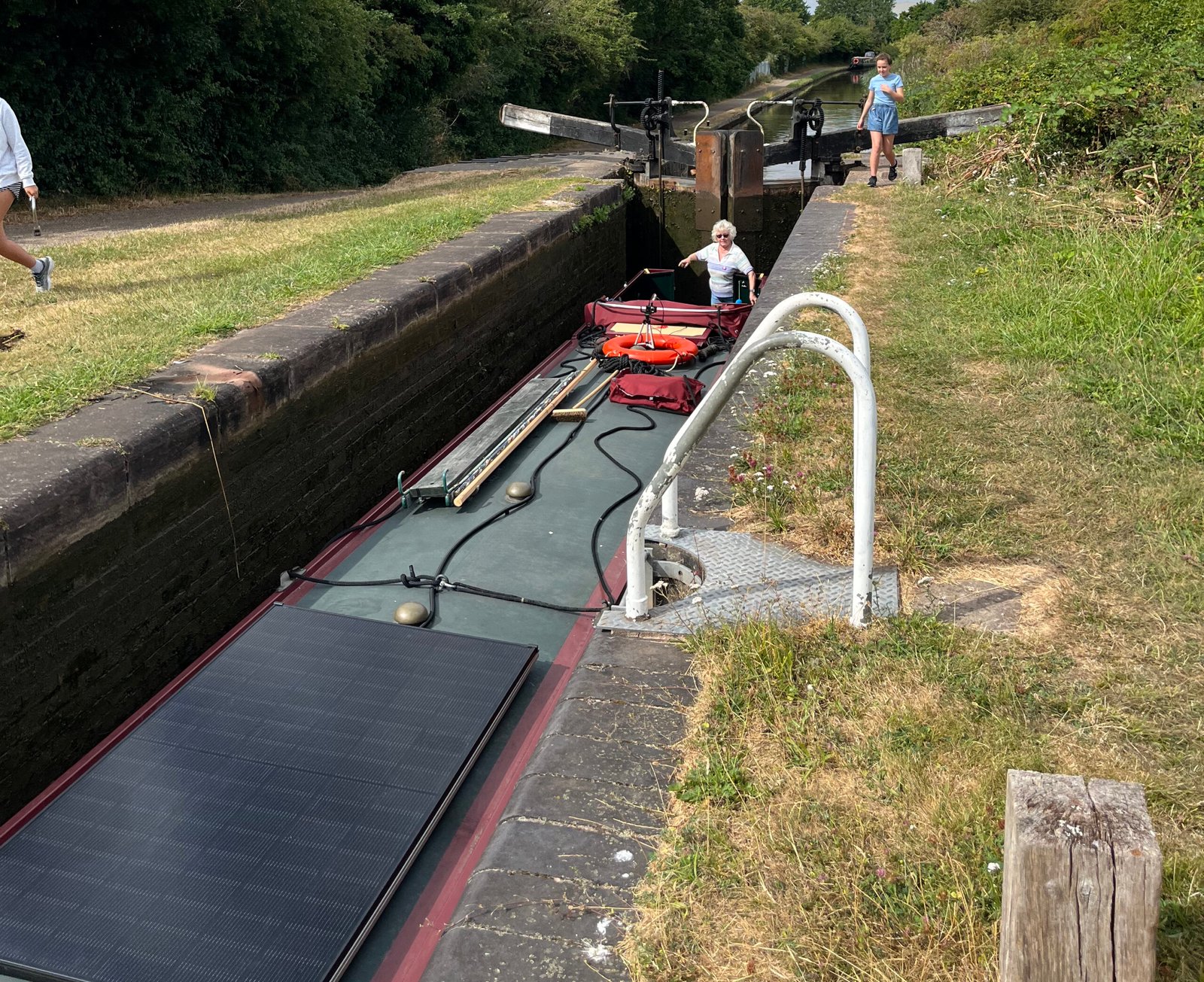
Portable power stations are becoming increasingly popular with narrowboat owners. But can one really replace a petrol or diesel generator, particularly if you live aboard all year round?
It’s an interesting question, and one that deserves rather more than a few enthusiastic claims about enormous batteries, solar panels and the possibility of never needing to run a generator again.
I’ve been living aboard boats for more than 25 years, first on our self-built sailing yacht, Ruffles Spray, and now on our 60-foot narrowboat, Rasmunda. During that time, I’ve installed, maintained and modified marine electrical systems, including 12V and 230V installations.
I’ve also learned something important: generating electricity aboard a boat is relatively straightforward in summer. It’s the middle of winter, when the days are short and the sky is grey, that separates a practical electrical installation from an optimistic one.
And that’s where the portable power station argument starts to become interesting.
What Exactly Is a Portable Power Station?
A portable power station is essentially a rechargeable battery, an inverter, a battery charger and various electrical connections packaged together in one convenient box.
Depending on the model, it might provide ordinary 230V sockets, USB charging ports, 12V outputs and connections for portable solar panels.
Some larger units can operate fairly demanding household appliances, including kettles, microwaves and even washing machines, provided their inverter output and surge capacity are sufficient.
Modern lithium iron phosphate (LiFePO4) batteries have made these products considerably more attractive. They’re generally lighter, more durable and capable of many more charge cycles than older lead-acid battery technology.
And I can certainly see their appeal.
You buy one, charge it, plug something in and it works. No complicated installation, no separate inverter and no immediate need to understand the finer points of marine electrical engineering.
For camping, occasional boating, emergency power and temporary electrical supplies, they can be excellent.
But there’s one word in the description that I think deserves particular attention.
Portable.
These devices are designed primarily to provide a convenient, self-contained source of stored electricity.
That’s not quite the same thing as designing an electrical generation and distribution system for a boat that’s somebody’s permanent home.
A Portable Power Station Doesn’t Generate Electricity
This is the first distinction we need to make.
A portable power station stores electricity. It doesn’t create it.
Of course, you can connect solar panels to recharge it. You can also recharge it from a mains supply, a suitable vehicle charging arrangement or, depending on the equipment, a generator.
But the energy still has to come from somewhere.
And if you consume more electricity than you’re putting back into the battery, sooner or later it will be empty.
That sounds obvious, doesn’t it?
Yet it’s remarkably easy to become distracted by the impressive capacity figures and forget the fundamental energy balance.
A petrol or diesel generator is different. Provided you have fuel, it can continue generating electricity for as long as it’s designed to operate.
A battery-powered station can only deliver the energy previously stored inside it.
That’s not an argument against batteries. We have a substantial lithium battery installation on Rasmunda ourselves.
It’s simply recognising that electricity storage and electricity generation are two different jobs.
The Difference Between Watts and Kilowatt-Hours
Before going any further, it’s worth clearing up two measurements that are frequently confused.
Watts (W) measure electrical power — how quickly an appliance uses electricity.
Kilowatt-hours (kWh) measure energy — how much electricity is consumed over time.
For example:
- A 1,000W appliance running for one hour consumes 1kWh.
- A 2,000W appliance running for half an hour also consumes 1kWh.
- A 100W appliance running for ten hours consumes 1kWh.
Our electric kettle aboard Rasmunda is rated at 3,000W.
That doesn’t mean it consumes 3kWh every time Ann makes a cup of tea.
If it runs for three minutes, it uses approximately 0.15kWh.
The distinction matters because a portable power station needs both sufficient inverter power to operate an appliance and sufficient battery capacity to keep it running.
A unit might have a 2,000Wh battery but only a 1,500W inverter. In that case, it cannot operate our 3,000W kettle directly, regardless of how much energy remains in its battery.
And even if it has a sufficiently powerful inverter, the battery will still need recharging.
Our Electrical Consumption Aboard Rasmunda
Now let’s move away from theoretical examples and look at what actually happens aboard our narrowboat.
Ann and I have a residential mooring, with metered shore power. We buy electricity from the marina at a current price of 29p per kilowatt-hour.
Our meter counts down as we use electricity, so we have a very practical indication of how much we’re consuming.
And our consumption changes considerably between summer and winter.
Winter: Approximately 5kWh Per Day
During winter, we typically use around 5kWh of shore electricity each day.
That includes our normal domestic electrical needs, such as:
- A 3,000W electric kettle.
- An 1,800W air fryer.
- A microwave.
- Television.
- Mobile phone and laptop chargers.
- Our MikroTik Wi-Fi equipment.
- Battery charging through our Victron inverter/charger.
We don’t use all these appliances continuously, of course. But over 24 hours, the electricity consumption adds up.
On dull winter days, when there is virtually no useful solar contribution, I tend to leave the Victron charger operating to maintain the batteries.
And here’s something I’ve learned from experience.
Winter solar generation can be disappointing, even when you have a reasonable-sized solar installation.
Summer: Approximately 2kWh Per Day From Shore Power
During summer, our shore electricity consumption drops dramatically, typically to around 2kWh per day.
Why?
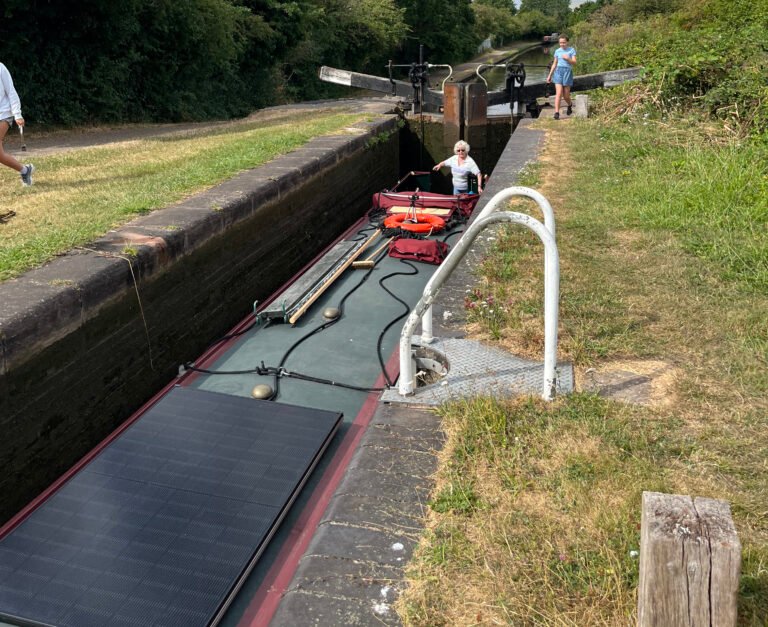
Because our 515W solar installation provides a substantial proportion of our electricity.
The remaining shore consumption comes largely from higher-powered appliances such as the kettle and air fryer.
Our Victron EasyPlus inverter/charger is configured to use its Conditional AC Input Connection facility.
In normal operation, smaller electrical loads can be supplied through the inverter from our lithium battery. When demand rises above approximately 800W, the system can connect to shore power.
The exact connection and disconnection thresholds are programmable.
This is quite different from simply setting a shore-power current limit. The conditional input arrangement determines when the inverter/charger connects to the available AC supply.
It means we can make good use of our stored solar energy while allowing the higher-powered domestic appliances to operate from shore power when required.
We have deliberately designed our electrical installation around the way we want to live.
Ann and I live aboard a boat, but we don’t believe that means we should have to compromise our lifestyle.
We want to use electrical appliances just as we would if we lived in a house or flat.
And our electrical system has been designed accordingly.
What Does That Electricity Cost?
At our current marina rate of 29p per kWh, the figures work out as follows:
| Winter | Summer | |
|---|---|---|
| Typical daily shore electricity | 5kWh | 2kWh |
| Daily cost | £1.45 | £0.58 |
| 30-day equivalent | £43.50 | £17.40 |
These figures represent electricity purchased from the marina, not a complete measurement of every watt-hour consumed aboard.
In summer, solar energy supplies much of the difference.
That’s an important distinction when comparing our installation with a boat that has no shore-power connection.
Heating and hot water are another important consideration when living aboard through winter. On Rasmunda, we use a diesel-fired Eberspacher system for hot water and additional heating, which I’ve covered in our article about installing an Eberspacher heating timer.
Could a Portable Power Station Supply Our Winter Electricity?
Let’s imagine we have a portable power station with a nominal battery capacity of 2kWh.
For the sake of comparison, let’s also imagine that we need to replace 5kWh of electricity each day.
Ignoring losses, that battery contains less than half the energy required.
In practice, AC inverter losses, battery management and other factors mean that the usable energy delivered to appliances may be somewhat less than the advertised battery capacity.
Suppose we could obtain 1.8kWh of useful AC energy from that 2kWh battery.
At an average consumption of 5kWh per day, we’d need to replenish the equivalent of nearly three full batteries every day.
And that’s assuming we have somewhere to obtain the charging energy.
A larger power station would last longer, certainly.
But increasing battery capacity doesn’t solve the underlying problem of how to recharge it.
It simply postpones the moment when recharging becomes necessary.
For occasional electrical use, that may be perfectly acceptable.
For somebody living aboard continuously, particularly through winter, it becomes a much more significant consideration.
Why Winter Solar Changes Everything
Solar panels are one of the best investments you can make in a narrowboat electrical installation.
We have 515W of solar aboard Rasmunda, connected through a Victron MPPT controller.
In summer, the system works extremely well.
But the difference between summer and winter is enormous.
In Britain, winter brings shorter daylight hours, a lower sun angle and frequently prolonged periods of cloud.
Even when the sky looks reasonably bright, the energy reaching the panels can be a fraction of what they receive on a clear summer day.
And I can tell you that this isn’t exclusively a British problem.
Even Mediterranean Winter Solar Can Be Poor
When we lived aboard Ruffles Spray in the Mediterranean, we experienced exactly the same fundamental issue.
Yes, the Mediterranean generally enjoys more sunshine than Britain.
But winter still brings overcast days, storms and periods of poor solar generation.
There were days when our panels produced very little useful electricity.
A solar panel’s advertised wattage is its output under specified test conditions, not a promise of what it will produce throughout the day.
A 500W array doesn’t deliver 500W continuously from sunrise to sunset.
And when the weather turns against you, increasing your battery capacity doesn’t magically make more solar energy available.
This is why I believe a full-time liveaboard electrical installation needs to be designed around the worst reasonable conditions, not the best summer afternoon.
How Much Solar Would You Need to Recharge a Power Station?
Let’s take a hypothetical portable power station with a 2kWh battery and a solar input capable of accepting 500W.
Under ideal conditions, you might imagine that four hours at 500W would fully recharge it.
But real charging takes longer.
Solar output varies with the weather, the sun’s position, panel orientation, temperature and shading. There are also charging losses.
On a good summer day, replenishing a 2kWh battery may be entirely practical.
On a heavily overcast winter day, the same panels might produce only a small fraction of their rated output.
If the panels generated an average of just 50W for four hours, they’d produce 0.2kWh before charging losses.
That’s only one-tenth of the nominal capacity of our hypothetical 2kWh battery.
And if you’re consuming several kilowatt-hours every day, the shortfall quickly becomes substantial.
These are illustrative calculations, not predictions of what a particular solar installation will produce. Actual winter generation depends on location, weather, panel arrangement and equipment.
The principle, however, is unavoidable.
You cannot continually consume more electricity than your system can generate or obtain from another source.
What About Charging a Portable Power Station From the Boat’s Engine?
This is another possibility frequently suggested.
And yes, charging a portable power station from an engine-driven electrical system can be practical.
Some manufacturers even offer dedicated alternator-charging equipment designed for their products.
But the available charging power depends on the alternator, existing boat loads, wiring, charging equipment and the station’s input limitations.
A conventional 12V accessory socket, for example, isn’t going to deliver the same charging performance as a properly engineered high-current alternator charging system.
And once you start adding specialised charging equipment, cables, protection and installation work, it’s worth asking a question.
Would that money be better invested in improving the boat’s existing electrical installation?
Perhaps a higher-output alternator, where compatible with the engine and charging system.
Perhaps a suitable battery-to-battery charger.
Or perhaps additional lithium battery capacity integrated with the existing system.
Those solutions can benefit the whole boat rather than a separate appliance.
That doesn’t make portable power stations useless. It simply means they aren’t automatically the most economical or practical way of improving an established narrowboat electrical system.
Can You Connect a Portable Power Station to a Narrowboat’s Existing 230V Wiring?
This is an area where I would urge particular caution.
It’s tempting to imagine connecting a portable power station to the boat’s existing 230V installation so that all the sockets work as normal.
But a narrowboat’s AC electrical installation may involve shore-power connections, an inverter/charger, protective earth arrangements, residual-current protection and neutral-to-earth bonding arrangements that change according to the operating mode.
Introducing another AC source requires proper consideration of all those elements.
You must also ensure that one source cannot inadvertently backfeed another.
A portable power station’s AC output may have a different earthing arrangement from a conventional marine inverter or generator.
Consequently, equipment that operates safely when plugged directly into the station might require additional engineering before it can safely supply an entire boat.
Never connect a power station to the boat’s wiring through a homemade plug-to-plug lead or an ordinary socket.
A properly engineered connection may be possible with suitable equipment, switching, protection and professional assessment.
But for me, that rather defeats the attraction of buying a simple portable power supply.
If I wanted a permanent additional source of 230V electricity aboard, I’d rather have it designed and installed as part of the boat’s electrical system.
For a portable power station, my preference would be to keep it separate and plug individual appliances directly into it, within the manufacturer’s limits.
That’s particularly useful for emergency or temporary power.
The Case for a Properly Integrated Marine Electrical System
Our experience aboard Rasmunda illustrates the advantage of integrating the different parts of an electrical installation.
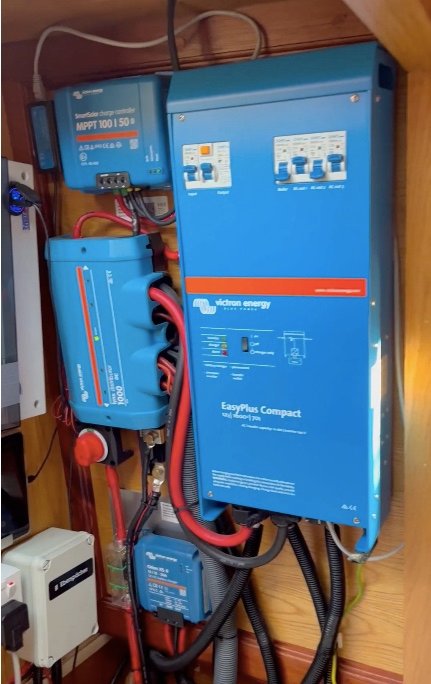
We have a 280Ah Fogstar LiFePO4 battery, 515W of solar panels, a Victron MPPT solar controller and a Victron EasyPlus inverter/charger.
These components work together to provide electricity in a way that suits our daily life.
The Victron’s Conditional AC Input Connection facility allows us to control when the available shore supply is connected, according to electrical demand.
Victron also offers programmable Assistants and other control arrangements that can be used in suitable generator start-and-stop systems.
That can be particularly useful when designing an installation for a continuous cruiser.
For example, a compatible generator-control system can be configured around battery charging requirements, subject to the capabilities of the equipment and the generator itself.
It isn’t a case of connecting any generator and expecting automatic operation. The controls, interfaces, electrical protection and operating conditions must all be suitable.
But it demonstrates an important point.
A properly designed marine electrical installation can manage multiple sources of energy as part of one system.
I’ve written several other articles about the electrical and technology systems we use aboard Rasmunda, which you can find in our Narrowboat Electrics & Technology section.
A portable power station, by comparison, is generally intended to operate as a self-contained unit, although some modern products do offer more advanced integration capabilities.
If We Were Continuous Cruisers, What Would I Install?
Ann and I are fortunate to have a residential mooring with metered shore electricity.
We’re not continuous cruisers.
But if we were, and I were designing our electrical installation from scratch, my priorities would be quite straightforward.
1. Keep the Solar Panels
Absolutely.
Solar is quiet, requires no fuel while operating and can make an enormous contribution during the brighter months.
I wouldn’t want to be without it.
2. Install a Suitable Lithium Battery Bank
Lithium batteries offer substantial advantages for many liveaboard installations, particularly their usable capacity, charging performance and cycle life.
But they need to be installed correctly, with appropriate battery management, protection and charging arrangements.
3. Make Proper Use of Engine Charging
If the engine is already running, it makes sense to use the available charging capability effectively.
That might involve upgrading the alternator or installing a suitable charging system, depending on the boat and engine.
But I would assess the whole system before making changes.
An alternator upgrade isn’t simply a matter of fitting the largest unit available. Belt capacity, engine speed, cooling, regulator behaviour and lithium battery charging demands all matter.
4. Have a Reliable Generator for When Solar Isn’t Enough
This is where my preference becomes clear.
For a full-time continuous cruiser with significant domestic electrical demands, I would seriously consider a properly installed, built-in diesel generator.
It would provide a dependable source of charging energy during prolonged periods of poor solar generation.
A suitable quiet portable petrol generator is another perfectly reasonable option, provided it is operated safely, outdoors and well away from the boat’s openings.
Petrol generators must never be operated inside a boat, engine compartment, enclosed cratch or other poorly ventilated space. Carbon monoxide is a potentially fatal hazard, and fuel storage and handling require particular care.
A built-in diesel generator also needs proper marine installation, including exhaust arrangements, cooling, fuel supply and electrical protection.
Neither option is maintenance-free or inexpensive to operate.
But both can generate electricity rather than merely store it.
And that, to me, is the crucial distinction.
What About the Cost?
Portable power stations can represent a substantial investment, particularly larger models with high-capacity batteries and powerful inverters.
Adding expansion batteries, dedicated solar panels and specialised charging accessories increases that investment.
A built-in marine diesel generator is also a significant purchase, and installation costs can be considerable.
A portable petrol generator may have a much lower initial purchase price, although running costs, servicing, noise and operating restrictions must be considered.
The important question isn’t simply which device costs less to buy.
It’s what does the entire electrical system cost to provide the energy you actually need, throughout the year?
If you already have a functioning inverter, lithium batteries, solar panels and engine charging, buying another large battery with its own inverter may duplicate equipment you already own.
That might make sense for emergency backup or a particular portable application.
But as the foundation of a permanent liveaboard electrical system, I would want to see a convincing technical and financial case first.
Where a Portable Power Station Makes Perfect Sense
Despite everything I’ve said, I certainly wouldn’t dismiss portable power stations.
They have genuine advantages.
For example, I can see one being useful aboard a narrowboat for:
- Providing emergency power for phones, laptops and essential small equipment.
- Supplying electricity while working away from the boat.
- Operating individual appliances without starting the engine.
- Providing temporary power during electrical maintenance.
- Acting as an independent backup if the main inverter or electrical installation develops a fault.
For somebody who only uses their narrowboat occasionally, a portable power station might even provide most or all of the electricity they require.
A low-consumption boater with sufficient solar generation and an effective charging plan could potentially avoid needing a separate generator altogether.
That’s entirely different from claiming that a power station can replace a generator for every full-time liveaboard.
The answer depends on how much electricity you consume and, most importantly, how you intend to replace it.
Living Aboard Shouldn’t Mean Living Without
There’s a wider point here, and it’s one Ann and I have followed throughout our lives aboard boats.
We didn’t build Ruffles Spray, leave Britain and spend 15 years cruising the Mediterranean because we wanted to make life unnecessarily difficult.
We did it because we wanted the freedom to live differently.
We discovered many of these lessons during our 15 years aboard Ruffles Spray in the Mediterranean. I’ve written more about that experience in Living on a Sailboat: How We Escaped the Rat Race.
And when we moved aboard Rasmunda, we took exactly the same approach.
We have a television, laptops, a microwave, an air fryer, an electric kettle and the other conveniences that make daily life comfortable.
We don’t see any reason to apologise for that.
Of course, electricity aboard a boat requires more thought than it does in a conventional house.
But that doesn’t mean the answer is to abandon the appliances you enjoy.
It means designing an electrical installation capable of supporting the way you actually live.
And after more than 25 years living aboard, that’s the approach I would recommend.
My Verdict: Can a Portable Power Station Replace a Narrowboat Generator?
Sometimes, yes. But not automatically, and certainly not without considering how it will be recharged.
For occasional use, low electrical consumption or emergency backup, a portable power station can be a very useful piece of equipment.
For somebody living aboard continuously, with substantial daily electrical demands, it’s a different proposition.
Our own experience aboard Rasmunda shows just how much the seasons affect electricity supply.
In summer, our solar panels provide a substantial amount of our energy, reducing shore-power purchases to around 2kWh a day.
In winter, that figure rises to around 5kWh a day, with very little useful solar generation during prolonged overcast weather.
And we experienced the same fundamental limitations of winter solar during our years in the Mediterranean.
If I were continuously cruising, I’d keep the solar panels, invest in a properly designed battery and charging installation, and have a reliable means of generating electricity when the weather doesn’t cooperate.
That might be a larger alternator, a built-in diesel generator or a suitable portable petrol generator, depending on the boat and its electrical requirements.
What I wouldn’t do is spend a considerable amount of money trying to make a portable battery system perform a job for which a properly integrated marine electrical installation might be better suited.
A portable power station can be an excellent addition to a narrowboat. But storing electricity is not the same as generating it.
And when you’re living aboard in the middle of a British winter, that difference matters.
What’s your experience? Do you use a portable power station aboard your narrowboat, or do you rely on solar, engine charging or a generator? I’d be interested to hear how your system performs during the winter months, particularly if you’re a continuous cruiser.