How much electricity does it actually take to live comfortably aboard a narrowboat? And how much does it cost? After more than 25 years of living aboard boats, first on our sailing boat Ruffles Spray and now our narrowboat Rasmunda, we’ve learned a thing or two about generating, storing and using electricity. Here are our real-life figures, along with some lessons learned along the way.
When people discover that Ann and I live aboard a narrowboat, one of the questions that occasionally comes up is how we manage our electricity.
Do we have to be careful about what appliances we use? Do we rely on solar panels? What happens during winter? And surely running things like a kettle, microwave or air fryer must be difficult?
Well, not really.
We’ve always taken the view that living aboard a boat shouldn’t mean sacrificing the everyday comforts we enjoy.
After all, we chose this lifestyle because we wanted freedom, not because we wanted to spend our lives worrying about whether there was enough electricity left to make a cup of tea.
But there’s an important difference between having electricity available and understanding where it comes from.
And that’s something I learned fairly early in our boating adventures.
Our First Boat Batteries Were a Disappointment
When we launched Ruffles Spray in July 2001, the sailing boat I’d spent almost five years building, our domestic electrical system included three 110Ah lead-acid leisure batteries.
That gave us a nominal capacity of 330Ah.
At the time, I thought that sounded like a reasonable amount of electricity storage.
Unfortunately, those batteries lasted approximately two years.
It was a useful, if rather expensive, lesson.
I began reading everything I could find about marine electrical systems. I remember studying publications by both British and American authors, including, I believe, Nigel Calder, whose books on boat electrical systems were particularly well regarded.
The more I learned, the more I realised that simply fitting batteries labelled ‘leisure’ didn’t necessarily mean they were ideally suited to the repeated charging and discharging experienced aboard a cruising boat.
Battery construction mattered. So did charging equipment, charging voltages, depth of discharge and the way the entire electrical installation worked together.
I decided it was time for a change.
The Trojan T-105 Batteries That Lasted Eleven Years
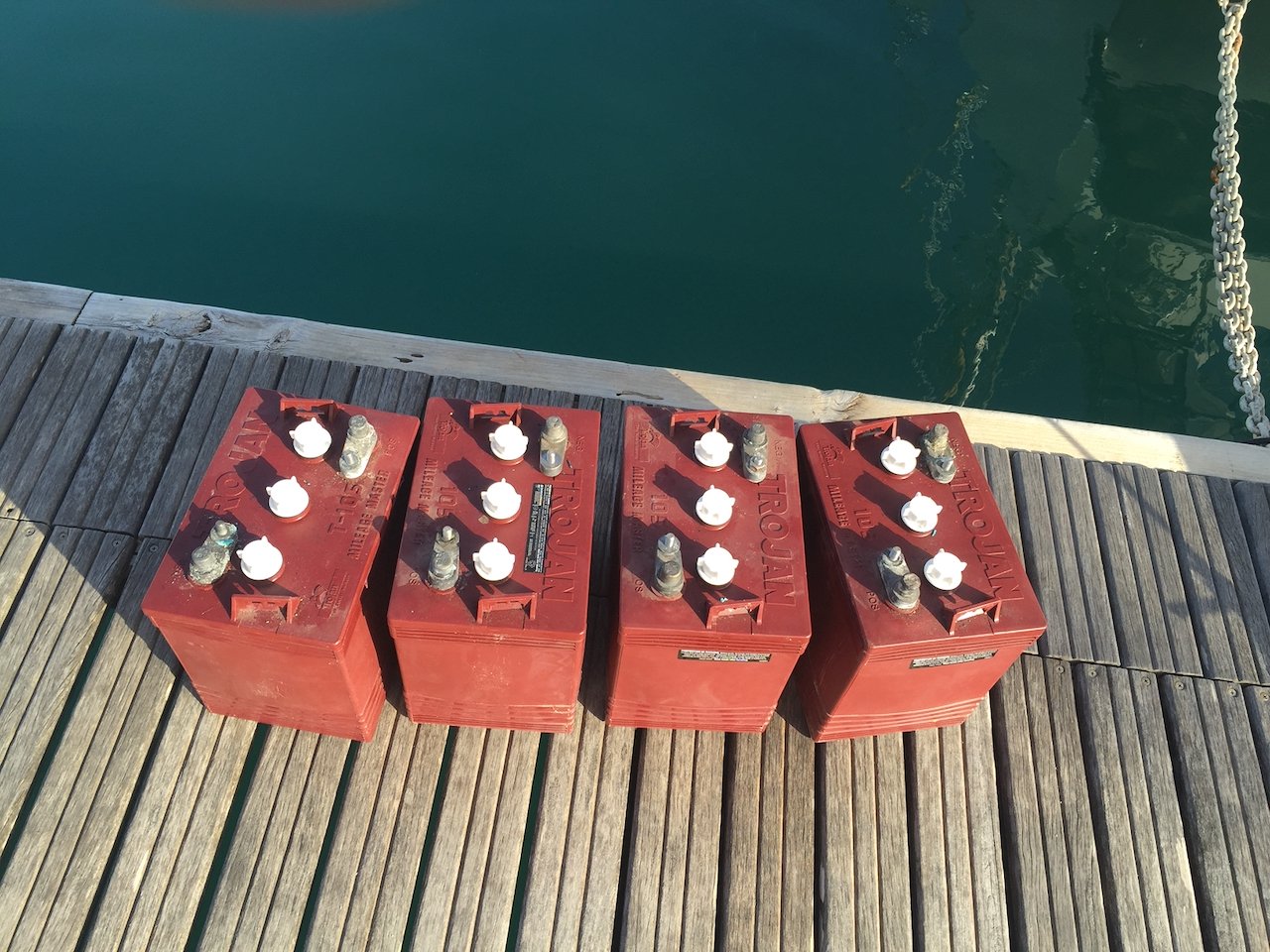
My replacement battery bank consisted of four Trojan T-105 6V, 225Ah deep-cycle batteries.
They were connected as two pairs in series, with those pairs connected in parallel to produce a 12V domestic battery bank.
That gave us a total nominal capacity of 450Ah.
But the most valuable part of the purchase wasn’t simply the batteries. It was a conversation I had with the Trojan distributor about how to get the longest possible life from them.
His advice was straightforward.
Don’t routinely discharge the batteries beyond 50% of their capacity. After discharging, recharge them to approximately 80% whenever practical. Then, at least once a month, use shore power or a generator to bring the batteries through a complete charging cycle.
He also explained the importance of using the correct charging voltages.
For our 12V bank of Trojan T-105 batteries, the charging settings were:
| Charging stage | Voltage |
|---|---|
| Bulk/absorption target | 14.8V |
| Float | 13.2V |
| Equalisation | 15.5V |
The equalisation voltage was used only when an equalisation charge was appropriate, not as part of every normal charging cycle. These were the settings used for our installation; charging voltages also need to account for battery temperature and the manufacturer’s instructions.
During normal cruising, I aimed to recharge the batteries to around 80% state of charge.
Why only 80%?
Because the final stages of charging flooded lead-acid batteries can take a considerable amount of time.
As the batteries approach full charge, the current they can accept gradually reduces. Completing the absorption stage can therefore mean running an engine or generator for hours while relatively little electricity is being stored.
By charging to around 80% during everyday cruising, we avoided much of that inefficient engine or generator running.
But there’s a catch.
Flooded lead-acid batteries shouldn’t be left indefinitely without reaching a full state of charge. Repeated partial charging can contribute to sulphation and reduced battery performance.
That’s why the distributor recommended a proper full charge at least once a month.
Whenever possible, we’d connect to shore power or use our generator, allowing the charger to reach the specified absorption voltage of 14.8V, complete the absorption stage and eventually transition to float.
There was also another important maintenance task.
Checking the electrolyte levels.
Flooded lead-acid batteries lose water during charging, particularly when charging voltages are relatively high.
That meant regularly checking the electrolyte and topping up with distilled water as required.
Follow that routine, the distributor suggested, and we should get around ten years of service from the battery bank.
It wasn’t a guarantee, simply practical advice from someone who understood the batteries he was selling.
And I followed it.
Our 450Ah battery bank provided approximately 225Ah of routinely usable capacity when limiting discharge to 50%.
The result? Our first set of Trojan batteries lasted eleven years.
When they eventually needed replacing, I bought another set.
Those replacements were still going strong when we sold Ruffles Spray.
Looking back, it was one of the best pieces of advice I received during our years cruising.
And it demonstrated something I’ve believed ever since: the quality of a battery matters, but how you charge and maintain it can be just as important.
Incidentally, I have Ann to thank for remembering the details of that conversation with the distributor. I’d originally remembered it as a ten-year guarantee. Fortunately, her memory is rather better than mine!
Charging Ruffles Spray’s Batteries
By this stage, Ruffles Spray had a substantial electrical installation.
Our engine charging system used a 120A Balmar alternator, controlled by an external regulator.
I can’t remember the exact regulator model, but external regulation allowed the charging system to be managed more appropriately for the battery bank than a basic automotive charging arrangement.
We also had four 90W solar panels, giving us 360W of installed solar capacity.
For shore power and 230V electricity, we used a Victron MultiPlus inverter/charger, with a 2500W inverter rating and a 120A battery charger.
That Victron was still working perfectly when we sold Ruffles Spray.
The combination gave us several ways of replenishing the batteries.
When cruising, the alternator could provide substantial charging current while the engine was running.
The solar panels contributed whenever conditions allowed.
And when shore power was available, the Victron charger could replenish the battery bank.
The important lesson was that battery capacity alone wasn’t enough.
You also needed a reliable means of replacing the energy you’d used.
There’s little point installing a huge battery bank if you can’t recharge it properly.
That lesson remains just as relevant today, even though battery technology has changed enormously.
From 450Ah of Lead-Acid to 280Ah of Lithium
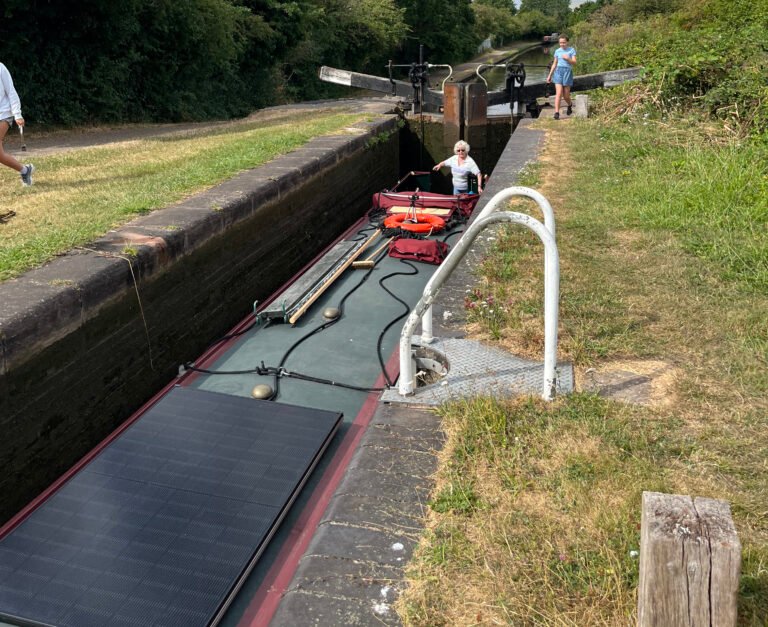
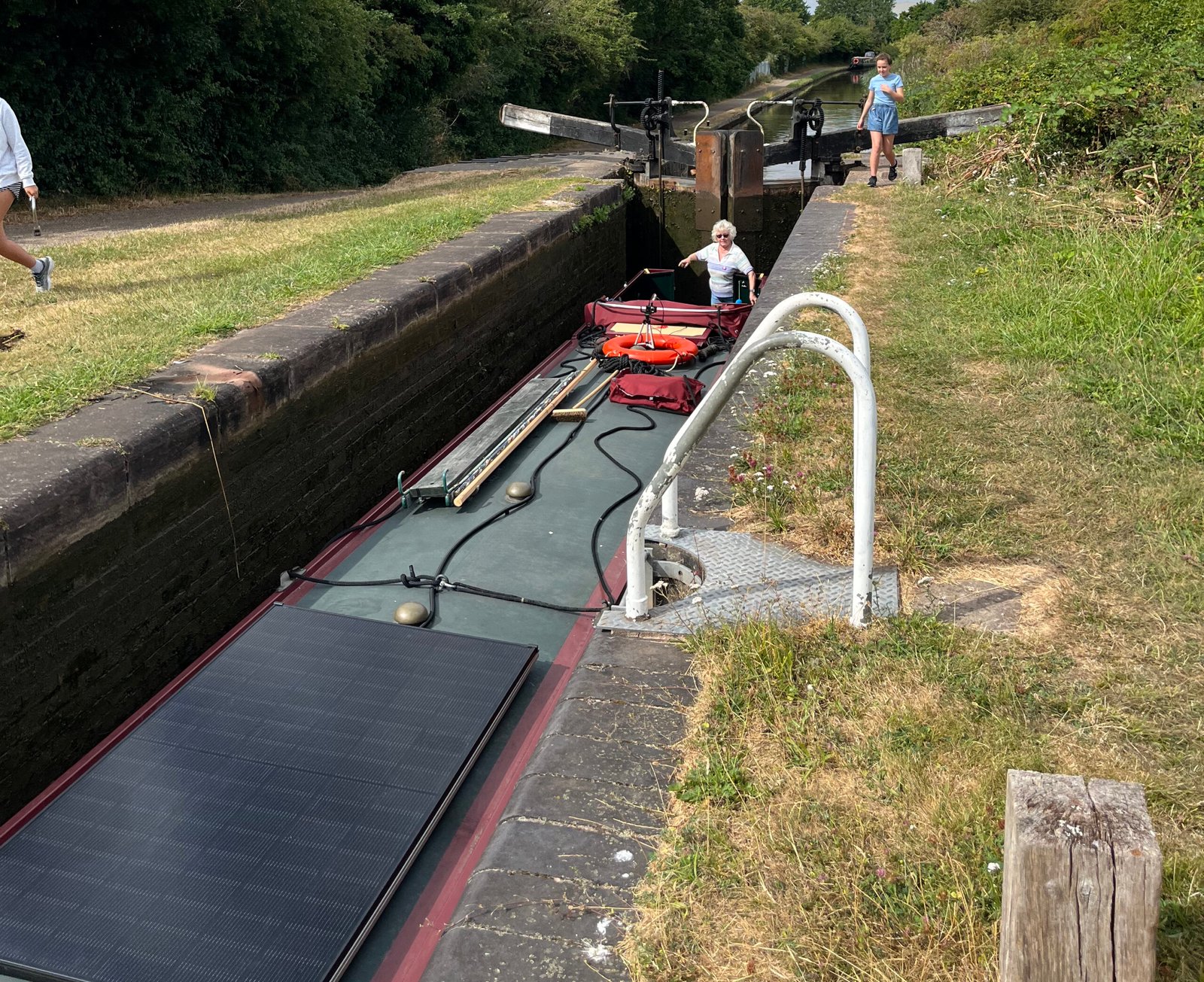
Fast-forward to life aboard Rasmunda, our 60-foot Colecraft narrowboat.
Today, our domestic battery bank consists of a single Fogstar 280Ah LiFePO4 lithium battery.
At first glance, that might sound like a considerable reduction in capacity compared with the 450Ah Trojan bank aboard Ruffles Spray.
But the figures don’t tell the whole story.
Lithium batteries can generally be discharged much further than traditional flooded lead-acid batteries without the same degree of impact on their working life.
For comparison, consider the following figures.
| Battery bank | Nominal capacity | Illustrative usable capacity |
|---|---|---|
| Original leisure batteries | 330Ah | 165Ah at 50% discharge |
| Trojan T-105 deep-cycle batteries | 450Ah | 225Ah at 50% discharge |
| Fogstar lithium battery | 280Ah | 252Ah at 90% discharge |
The 90% depth of discharge shown for the lithium battery is an illustrative comparison, rather than a recommendation to operate our particular battery at that level every day.
What’s remarkable is that our single 280Ah lithium battery can actually provide more usable capacity than the four Trojan T-105 batteries aboard Ruffles Spray.
At a 50% depth of discharge, our 450Ah Trojan bank provided approximately 225Ah of usable capacity. By comparison, our 280Ah Fogstar lithium battery could provide approximately 252Ah at an illustrative 90% depth of discharge.
That’s around 12% more usable capacity, from a single battery that occupies considerably less space and weighs substantially less than the four flooded lead-acid batteries.
There’s another major advantage.
Lithium batteries can accept charging current much more readily over a large part of their charging range.
Anyone who has lived with a substantial flooded lead-acid battery bank will be familiar with the time required to complete the final stages of charging.
As lead-acid batteries approach full charge, their acceptance current reduces, and completing the charging process can take a surprisingly long time.
Lithium batteries behave differently.
Provided the charging equipment, battery management system and operating conditions allow it, they can accept substantial charging currents for much longer.
For a boater relying on engine or generator charging, that can make an enormous difference.
It’s one of the clearest examples of how battery technology has advanced during our years living aboard.
However, I wouldn’t dismiss lead-acid technology.
Our Trojan batteries gave us excellent service, and their longevity demonstrated what a properly designed and maintained electrical installation could achieve.
Lithium has changed what’s possible, but good electrical engineering still matters.
Rasmunda’s Electrical Installation Today
Our current installation aboard Rasmunda consists of:
- Fogstar 280Ah LiFePO4 lithium battery
- 515W solar panel installation
- Victron SmartSolar MPPT 100/50 solar controller
- Victron EasyPlus 1600/70 inverter/charger
- Victron Orion 12/50 DC-to-DC charger
- Metered 230V shore power supplied by our marina
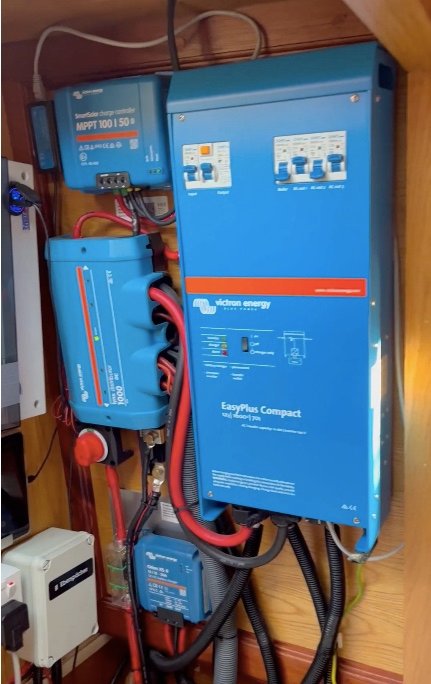
It’s a system designed around how we actually live.
We have a television, laptops, phones, our onboard Wi-Fi system and all the usual electrical equipment you’d expect to find aboard a modern narrowboat.
We also use a 3kW electric kettle, an approximately 1.8kW air fryer and a microwave.
Some of those appliances draw considerably more power than our inverter can continuously supply by itself.
But that isn’t a problem because our Victron system is configured to manage the relationship between inverter power and shore power automatically.
How Our Victron System Uses Shore Power
Our Victron EasyPlus combines an inverter, battery charger and AC switching functionality.
One particularly useful feature is its conditional AC input connection capability.
I’ve configured the system so that the inverter can supply smaller electrical loads while shore power remains available.
When we switch on a high-powered appliance, such as the kettle, the system automatically connects to shore power.
Once the demand falls below the configured switching threshold, it can return to inverter operation.
That means we don’t have to manually change power sources every time we want to use an appliance.
The system handles the switching.
This arrangement is different from simply limiting the amount of current drawn from the shore supply.
Victron’s shore-current limiting and conditional AC input connection functions serve different purposes.
For us, the important thing is that the electrical installation operates largely in the background.
We can get on with living aboard without constantly thinking about which power source is supplying the electricity.
Why We Chose a Residential Mooring
When Ann and I moved aboard Rasmunda, we made a deliberate decision to have a residential mooring rather than become continuous cruisers.
Having spent many years cruising aboard Ruffles Spray, we knew exactly what living without a permanent shore-power connection involved.
This time, we wanted a permanent base, with the convenience of metered shore electricity, while retaining the freedom to take Rasmunda cruising whenever we wished.
That decision has influenced the way I’ve designed our electrical installation.
With shore power available, we don’t need to generate every kilowatt-hour ourselves. Our lithium battery and solar panels still play an important role, but we have the convenience of connecting to the marina’s electricity supply whenever necessary.
However, this arrangement isn’t necessarily how I’d design an electrical system for someone living aboard and continuously cruising.
And our circumstances will change again in spring 2028, when I retire.
Our plan is to keep our residential mooring but spend much more time cruising the waterways during the warmer months, roughly May through September.
That will mean relying more heavily on our solar panels, lithium battery and engine charging while we’re away from the marina.
It’s a very different proposition from spending an entire winter continuously cruising without shore power.
And it raises an interesting question.
If we were starting again as full-time continuous cruisers, how would I design our electrical system?
That’s a subject I intend to explore in a separate article.
How Much Electricity Does Rasmunda Actually Use?
Now we come to the figures that prompted this article.
Because our marina supplies metered electricity, we can see how much electricity we purchase.
And there’s a considerable difference between summer and winter.
Winter Electricity Consumption
During winter, we typically purchase approximately 5kWh of electricity per day.
Our marina currently charges around 29p per kWh.
That gives us the following costs:
| Period | Shore electricity purchased | Cost |
|---|---|---|
| One day | 5kWh | £1.45 |
| Seven days | 35kWh | £10.15 |
| 30 days | 150kWh | £43.50 |
So, during a typical winter month, we spend approximately £43.50 on shore electricity.
That includes the electricity consumed by our Victron battery charger.
During winter, solar generation is frequently limited, so shore power supplies most of our electrical energy.
However, there’s an important distinction here.
These figures represent electricity purchased from the marina.
They don’t necessarily represent our entire electrical consumption, because any electricity supplied by our solar panels doesn’t pass through the marina meter.
Summer Electricity Consumption
During summer, our shore electricity purchases fall considerably.
With longer daylight hours and much better solar production, we typically purchase approximately 2kWh per day.
| Period | Shore electricity purchased | Cost |
|---|---|---|
| One day | 2kWh | £0.58 |
| Seven days | 14kWh | £4.06 |
| 30 days | 60kWh | £17.40 |
That’s approximately £17.40 for a 30-day summer month.
The difference between our typical winter and summer shore-power costs is £26.10 over 30 days.
Naturally, these are representative figures. Weather conditions, appliance use and battery charging all influence the daily totals.
And while solar generation accounts for much of the seasonal difference, our figures don’t establish exactly how many kilowatt-hours the panels produce.
For that, we’d need to examine the solar controller’s recorded energy yield.
Nevertheless, the reduction in purchased electricity is substantial.
Why Solar Makes Such a Difference
Our 515W solar installation makes a significant contribution during summer.
But it’s worth remembering that a solar panel’s rated output isn’t the same as the amount of electricity it will generate throughout the day.
A 515W installation doesn’t continuously produce 515 watts whenever the sun is above the horizon.
Output depends on sunlight intensity, cloud cover, shading, panel orientation and other factors.
And winter is a very different proposition from summer.
On a narrowboat, solar panels are commonly installed relatively flat.
That’s convenient, but it isn’t ideal when the winter sun is low in the sky.
Combine that with short daylight hours and prolonged overcast weather, and solar generation can become disappointingly small.
We experienced similar problems during our years cruising the Mediterranean.
People sometimes imagine that solar panels in Greece must produce abundant electricity all year round.
During summer, they certainly can be very productive.
But winter is another matter entirely.
Several days of cloud and rain can make a considerable difference to the energy available.
The Mediterranean might enjoy a warmer climate than the UK, but solar panels still need sunlight.
How I Manage Our Lithium Battery in Winter
During winter, I generally leave the Victron charger maintaining our Fogstar lithium battery.
That means the battery normally remains at a relatively high state of charge.
Occasionally, however, I’ll switch off the charging function while leaving shore power available.
This allows the battery to supply some of our electrical demand.
Once the battery has discharged by approximately 20%, I’ll switch the charger back on and replenish it.
For our 280Ah battery, a 20% discharge represents approximately 56Ah, or around 0.72kWh of nominal stored energy.
I don’t do this because lithium batteries require regular cycling to avoid a memory effect. They don’t.
I simply prefer to let the battery do some work rather than keeping it permanently on charge.
Fogstar also discusses the importance of maintaining accurate state-of-charge readings within its battery management system.
Occasional shallow cycling and a full state-of-charge recalibration procedure are not necessarily the same thing, and any specific calibration procedure should follow the manufacturer’s instructions.
One of the advantages of our installation is that we have the flexibility to operate the battery this way without losing access to shore power.
Understanding Watts and Kilowatt-Hours
There’s one aspect of boat electrics that frequently causes confusion.
The difference between watts and kilowatt-hours.
Watts measure power: how quickly an appliance uses electricity at a particular moment.
Kilowatt-hours measure energy: how much electricity it consumes over time.
Take our 3kW kettle.
It draws a substantial amount of power while operating.
But if it runs for only three minutes, it consumes approximately:
3kW × 0.05 hours = 0.15kWh
Now compare that with a small 20W electrical device running continuously.
Over 24 hours, it consumes:
0.02kW × 24 hours = 0.48kWh
So a device drawing only 20 watts can consume more than three times as much electricity over a day as our kettle does during one three-minute boil.
That’s why looking only at appliance wattages can be misleading.
For anyone planning an electrical installation, understanding daily energy consumption is essential.
What About Narrowboats Without Shore Power?
Our circumstances are different from those of someone continuously cruising.
Because we have metered shore power, we can purchase electricity whenever solar generation is insufficient.
A continuous cruiser doesn’t have that option unless they visit a mooring or marina offering electricity.
Instead, they need to generate or replenish the energy they consume.
That might involve solar panels, engine alternator charging, a properly installed generator or a combination of several methods.
And winter is where the challenges become particularly apparent.
If a boat genuinely consumes 5kWh of electrical energy every day, that energy has to be replaced.
A large lithium battery bank might allow several days between charging sessions, depending on its capacity and the loads involved.
But eventually, the energy must be replenished.
The battery doesn’t generate electricity.
It merely stores it.
This is something I discussed in our recent article about whether portable power stations can replace petrol generators aboard narrowboats.
Portable power stations can be extremely useful for particular applications, but they’re still rechargeable batteries.
They don’t eliminate the need for an energy source.
For continuous cruisers, the most important question isn’t simply how much battery capacity to install.
It’s how you’re going to replace the electricity you use, particularly during winter.
Does a Bigger Battery Mean Lower Electricity Costs?
Not automatically.
Installing a larger battery bank gives you more stored energy.
It may allow you to make better use of solar generation, operate appliances for longer between charging sessions or reduce the frequency of engine and generator running.
But it doesn’t create electricity.
If you consume 5kWh from a battery and subsequently recharge it from shore power, you’ll need to purchase at least that amount of energy, with additional electricity required to account for charging and conversion losses.
A larger battery can improve flexibility and help you use energy more efficiently.
It doesn’t necessarily reduce the total energy required to support your lifestyle.
This is one of the reasons I believe electrical systems should be designed around actual consumption rather than simply fitting the largest battery bank possible.
What More Than 25 Years of Living Aboard Has Taught Us
Looking back, the electrical installation aboard Ruffles Spray was considerably more sophisticated than the original three leisure batteries we started with.
But it took time, research and a few lessons along the way to get there.
The Trojan batteries were a major improvement, not simply because they were larger, but because they were proper deep-cycle batteries supported by suitable charging equipment and a carefully managed charging routine.
The Balmar alternator, external regulator, solar panels and Victron MultiPlus all played their part.
And the results were impressive.
Eleven years from the first Trojan bank, with the replacement set still performing well when we sold the boat.
Today, aboard Rasmunda, lithium technology has transformed the way we store and use electricity.
Our single 280Ah Fogstar battery offers substantial usable capacity, faster charging capability and far less maintenance than our old flooded lead-acid bank.
The Victron equipment manages our electrical supply, while our 515W solar installation substantially reduces the amount of electricity we purchase during summer.
But the underlying principles haven’t changed.
You still need to understand how much electricity you consume.
You still need enough storage for your requirements.
And, most importantly, you still need a reliable way of replacing the energy you’ve used.
Technology has made all of this easier, but it hasn’t changed the laws of physics.
So, How Much Does Electricity Cost on Our Narrowboat?
For Ann and me, the answer is surprisingly modest.
During winter, our typical shore electricity purchases cost approximately £1.45 per day.
During summer, that falls to approximately 58p per day.
Of course, those figures reflect our particular circumstances.
We have a metered residential mooring, a substantial solar installation, lithium battery storage and a Victron inverter/charger system.
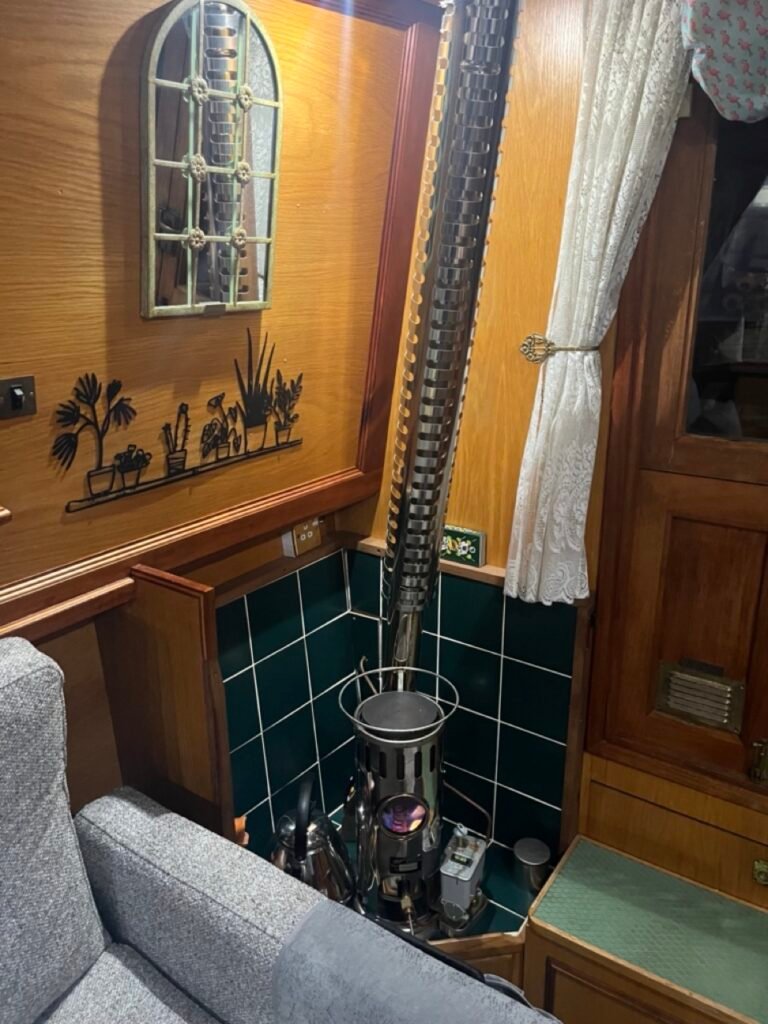
Our electricity figures also exclude the diesel used for our Refleks stove and Eberspächer heating system.
They aren’t a complete calculation of every cost associated with living aboard, nor do they include the purchase and eventual replacement costs of our electrical equipment.
A continuously cruising narrowboat will have different costs, particularly when engine running time, fuel consumption and generator maintenance are considered.
But our experience demonstrates that living aboard doesn’t necessarily mean sacrificing modern electrical conveniences or spending a fortune on electricity.
After more than 25 years of living aboard boats, we’ve never believed that choosing this lifestyle should mean giving up the things that make everyday life comfortable.
For us, the key has always been to build an electrical system that supports the way we want to live.
Not to change the way we live to accommodate the electrical system.
And I think that’s a pretty good principle for any boat owner to follow.
How much electricity does your narrowboat use? Do you have shore power, or do you generate everything yourself while cruising? And if you’ve made the switch from lead-acid to lithium, what difference has it made?
We’d love to hear about your experiences in the comments.